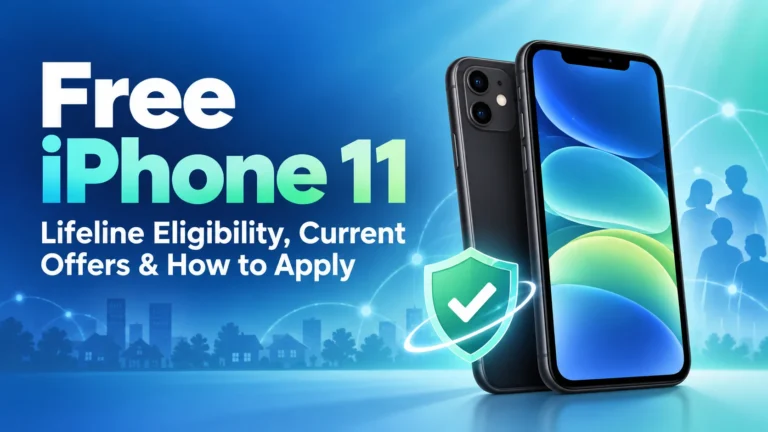
A free iPhone 11 is possible for people from many walks of life. Students, seniors, single parents, veterans, workers, and people with disabilities may all apply. The key is not your job title or age. You must meet the program rules, live where a participating provider operates, and find the phone in stock.
Qualified applicants may pay $0 for the phone through a limited Lifeline provider offer. Other applicants may see the iPhone 11 for a small one-time price. The exact amount can change by ZIP code, inventory, and phone condition. Approval does not guarantee an iPhone 11, so always review the final order before you submit it.
The guide below explains every realistic route. It covers Lifeline, current provider offers, carrier switch deals, trade-ins, used phones, application steps, required documents, and the checks that matter before you accept an older iPhone.
Can You Really Get a Free iPhone 11?
Yes, but the offer is not automatic or available to everyone at all times.
The federal government does not mail iPhones to applicants. Lifeline gives eligible households a monthly discount on phone or internet service. Some participating phone companies add a free or discounted device as their own promotion. The company—not Lifeline—decides which models it offers.
At the time of this review, the official AirTalk Wireless iPhone 11 page displayed the 64GB model for $0 with a Lifeline-supported monthly plan. AirTalk marked the phone “Almost Gone,” which shows why availability cannot be promised.
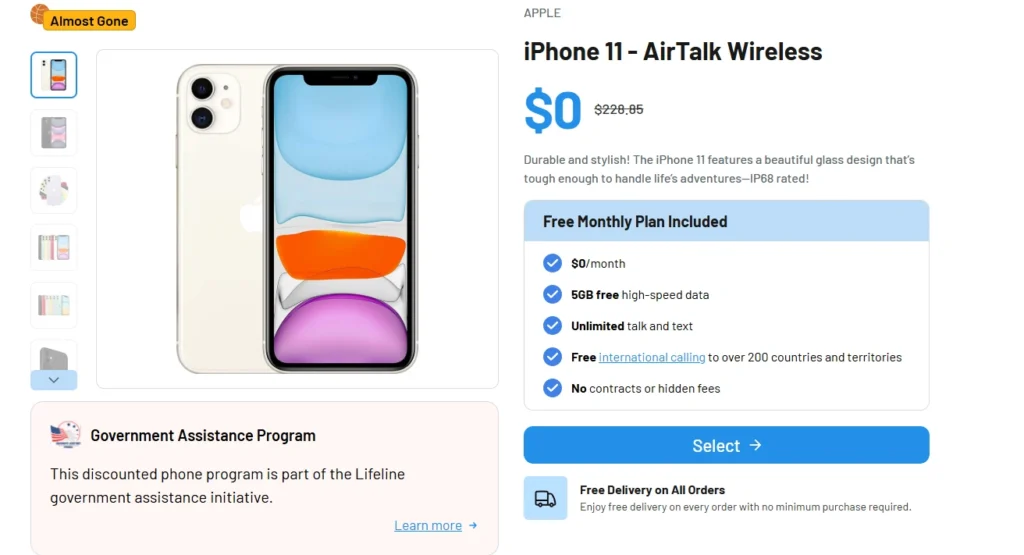
AirTalk’s live page also listed a $0 monthly plan with 5GB of high-speed data, unlimited talk and text, international calling to more than 200 countries and territories, and free delivery. Benefits can differ by state. Read the checkout page and terms for the offer tied to your address.
One important warning: another AirTalk device listing may show a paid price for the same model. That can happen when a promotion, state, device condition, or inventory group differs. The price in your approved, ZIP-based checkout is the amount that matters.
Quick Answer: Your Main Options
| Route | Can the iPhone 11 cost $0? | Main condition | What to watch |
|---|---|---|---|
| Lifeline provider offer | Yes, when available | Lifeline approval and local stock | Model, price, and condition can change |
| Low-cost Lifeline upgrade | Sometimes nearly free | Eligibility plus a small device payment | Shipping, upgrade, or activation charges |
| Carrier switch promotion | Possible, but uncommon for this older model | Port-in, plan, and sometimes trade-in | Long bill-credit term and high plan cost |
| Trade-in | Possible if the credit covers the price | Eligible phone in accepted condition | Final trade-in value may be lower |
| Refurbished or donated phone | Sometimes | Local program rules or limited stock | Battery health, lock status, and warranty |
The Best Current Route: A Lifeline Provider
Lifeline is a federal benefit that reduces the monthly cost of phone, internet, or bundled service. It currently provides a discount of up to $9.25 per month for most qualifying households. The support can reach $34.25 per month on qualifying Tribal lands.
The discount pays toward service. A free iPhone is not a guaranteed federal benefit. Providers may use their own promotions, refurbished inventory, or business funds to include a device.
AirTalk currently advertises an iPhone 11 offer. Other Lifeline companies may provide a free smartphone, but they often assign the model based on available stock. Do not assume that a general “free phone” advertisement means an iPhone 11.
Before applying, compare coverage, data, replacement rules, and phone selection. Our AirTalk Wireless guide explains the provider in more detail. You can also review our Lifeline provider comparison before choosing a company.
Who Qualifies for Lifeline?
You may qualify through household income or participation in an approved assistance program. Meeting one route is enough.
Program-based eligibility
You or someone in your household may qualify through:
- Medicaid
- Supplemental Nutrition Assistance Program, or SNAP
- Supplemental Security Income, or SSI
- Federal Public Housing Assistance, including some Section 8 and public housing programs
- Veterans Pension and Survivors Benefit
- Approved Tribal assistance programs for people living on qualifying Tribal lands
The official Lifeline qualification page contains the full program list.
Income-based eligibility
A household may also qualify when its income is at or below 135% of the Federal Poverty Guidelines. The limit changes with household size and is higher in Alaska and Hawaii.
For 2026, the limit for the 48 contiguous states, Washington, D.C., and U.S. territories is:
| Household size | Maximum annual income |
|---|---|
| 1 | $21,546 |
| 2 | $29,214 |
| 3 | $36,882 |
| 4 | $44,550 |
| 5 | $52,218 |
| 6 | $59,886 |
| 7 | $67,554 |
| 8 | $75,222 |
Add $7,668 for each person above eight. Check the official page before applying because the figures normally change each year.
Special survivor eligibility
Survivors of domestic violence, human trafficking, or related crimes may qualify for up to six months of emergency Lifeline support under expanded rules. Accepted routes may include WIC, a current Pell Grant, free or reduced-price school meals, or income at or below 200% of the poverty guidelines. Extra requirements apply, including proof of an attempted line-separation request.
Lifeline Rules You Should Know
Lifeline is limited to one benefit per household, not one benefit for every person at the same address. A household means people who live together and share money and expenses. Separate economic households at the same address may need to complete a household worksheet.
You must use a free Lifeline service at least once every 30 days. You may also need to recertify each year. Report a change in address or eligibility to your provider. Selling or transferring the benefit is not allowed.
The Affordable Connectivity Program, or ACP, ended in 2024. Websites that still promise an ACP iPhone 11 are using outdated information. Lifeline remains the main federal program to check.
How to Apply for a Free or Low-Cost iPhone 11
1. Confirm that you qualify
Choose either the income route or an accepted benefit program. Do not upload more personal information than the application requests.
2. Check providers at your address
Enter your ZIP code on a participating company’s official site. Service and device choices vary by location. Look at the iPhone 11 listing only after the site has loaded the options for your area.
3. Review the phone offer
Check all of the following:
- Final device price
- Storage capacity
- New, used, or refurbished condition
- Shipping and activation costs
- Monthly data amount
- Network coverage
- Return and replacement policy
- Whether the phone is locked
A large crossed-out price does not matter if the final checkout adds charges you did not expect.
4. Complete the Lifeline application
You can apply online through the National Verifier, apply with a participating company, or send a paper form by mail. Oregon and Texas use state-specific application systems.
5. Upload proof if requested
Automated systems may confirm your eligibility. If they cannot, you may need to provide documents. A clear and current document can prevent delays.
6. Select the iPhone 11 if it remains available
Approval for Lifeline does not reserve a phone. Select the iPhone 11 only if it appears in your approved device list. If it is gone, compare the free replacement with any paid upgrade instead of rushing.
7. Read the order summary
Take a screenshot or save a copy. Confirm the device, service, shipping, taxes, and total due. Never pay through a gift card, cryptocurrency, or a person who contacts you on social media.
Documents You May Need
The application may request:
- Full legal name and date of birth
- Home address
- Last four digits of a Social Security number or another accepted identity document
- Benefit statement, approval letter, or program card
- Tax return, pay stubs, or another income record
- Proof of address
- Tribal identification or program record, when relevant
A SNAP EBT card by itself may not show the name or active benefit period needed for verification. A recent agency letter can be stronger proof. Cover unrelated account numbers before uploading a document when the instructions permit it.
Is the iPhone 11 Still Worth Getting?
The iPhone 11 was released in 2019, but it still covers many everyday needs. Apple’s iPhone 11 specifications list a 6.1-inch Liquid Retina LCD, A13 Bionic chip, Face ID, dual 12-megapixel rear cameras, a 12-megapixel front camera, Wi-Fi 6, and Qi wireless charging.
The phone records 4K video and comes in 64GB, 128GB, and 256GB versions. Lifeline listings commonly feature 64GB models. That capacity can fill quickly if you save many photos or videos.
The biggest limit is mobile connectivity. The iPhone 11 supports LTE, not 5G. A provider may describe its service plan or network as 5G, but an iPhone 11 itself cannot connect to 5G radio bands. It will use the provider’s compatible LTE network.
Battery condition also matters more than the original battery claim. A refurbished iPhone may have years of prior use. Ask whether the seller promises a minimum battery capacity. After activation, open Settings > Battery > Battery Health & Charging to see the maximum capacity and any service warning.
What to Check Before Accepting a Used or Refurbished iPhone 11
Activation Lock
The phone must not be linked to the previous owner’s Apple Account. A device showing an Activation Lock screen cannot be properly set up without that person’s credentials. Do not buy or accept it on a promise that the lock can be removed later.
Carrier lock and compatibility
Ask whether the phone is locked to the provider. Read its unlocking policy. A locked phone may work well now but limit your choices later.
Battery health
A weak battery can turn a free phone into an expensive repair. Check maximum capacity and whether iOS reports an unknown or non-genuine part.
Screen, cameras, and Face ID
Test touch response across the whole screen. Open both cameras, record audio, make a call, and test Face ID. Also check the Lightning port, speakers, microphone, Wi-Fi, and Bluetooth.
Water resistance
Apple gave the iPhone 11 an IP68 rating when new. Water resistance can decline with age, wear, and repairs. Treat a used model as vulnerable to water.
Warranty and return period
Find out how many days you have to report a defect. A short written warranty is better than a verbal promise.
Can You Get One Free When You Switch Carriers?
Carrier switch promotions are another route, but old iPhone 11 deals are less common than offers on newer budget phones. A carrier may use “free” to describe monthly bill credits rather than an immediate discount.
A switch deal can require:
- A new line
- Transfer of an eligible phone number
- A specific unlimited plan
- AutoPay
- Sales tax on the full phone price
- A qualifying trade-in
- Service for 24 or 36 months
Leaving early may stop future credits and make the remaining phone balance due. Compare the total service cost, not only the device price.
Prepaid companies can run shorter promotions. For example, Total Wireless advertises free phones with selected plans, but its current free-device list does not promise an iPhone 11. Check the live model list before switching.
Can Apple Give You a Free iPhone 11?
Apple no longer sells the iPhone 11 as a new current model. Apple Trade In may provide credit for an eligible device, but the credit normally applies toward a newer purchase or an Apple Gift Card. It is not a government giveaway.
The iPhone Upgrade Program guide explains Apple financing and upgrade choices. That program is designed for newer phones and monthly payments, not a free iPhone 11.
Other Honest Ways to Pay Little or Nothing
Buy a refurbished phone from a trusted seller
A refurbished iPhone 11 may cost far less than a new iPhone. Look for a return window, battery promise, clean IMEI, and written condition grade. “Renewed” does not always mean Apple-certified.
Use a trade-in or store credit
An old phone, gift card, loyalty reward, or employer reimbursement could cover most or all of the price. The phone is effectively free to you only when the credits truly equal the total cost.
Ask local device-access programs
Schools, workforce agencies, domestic violence organizations, veteran groups, disability programs, and nonprofits sometimes provide donated phones. Stock is local and limited. Many programs lend devices or offer basic Android phones instead of iPhones.
Choose a lower-cost iPhone if the 11 is unavailable
An older model may be easier to find through a provider, but compare its software support and battery condition first. Our guides cover the free iPhone 8, free iPhone 7, and free iPhone 6. A slightly newer paid phone may offer better value than a very old free device.
Common Free iPhone 11 Scams
Walk away when a person or website:
- Guarantees approval without checking eligibility
- Claims every SNAP or Medicaid recipient receives an iPhone 11
- Requests a fee through gift cards, crypto, wire transfer, or cash app
- Asks for your EBT PIN or online benefit password
- Uses “ACP” as if that program still accepts applications
- Hides the provider name, service terms, or return policy
- Promises an unlocked, brand-new model without showing it in the order
- Pressures you to send identity documents through social media
Use the provider’s official website. Type the address yourself when possible. A social-media ad can be real, but the application should lead to the company’s secure domain.
Frequently Asked Questions
Can I get a free iPhone 11 with SNAP?
SNAP can make your household eligible for Lifeline. A participating provider may then offer an iPhone 11 for $0 or a low one-time price. SNAP does not guarantee that model.
Can I get one through Medicaid?
Yes, Medicaid is an accepted Lifeline qualification program. You still need approval, provider coverage, and available iPhone 11 stock.
Is there a free iPhone 11 for seniors?
Age alone does not qualify someone for Lifeline. A senior may qualify through income, Medicaid, SSI, Federal Public Housing Assistance, Veterans Pension, or another accepted route.
Can students or single parents qualify?
Yes. Students and single parents may apply under the same rules as everyone else. SNAP, Medicaid, SSI, housing assistance, or qualifying household income may establish eligibility.
Is the phone new?
It may be used or refurbished. Confirm the condition before ordering. Color, storage, cosmetic grade, and battery condition may vary.
Will I pay a monthly phone bill?
Some Lifeline plans cost $0 per month. Others offer a discount against a paid plan. Extra data, international services, replacement devices, or upgrades can cost more.
Can I keep my current number?
Often, yes. Do not cancel your old service first. Ask the new provider what account number, transfer PIN, and active-service status it needs.
Can I apply more than once to improve my chances?
No. Lifeline allows only one benefit per household. Duplicate enrollment can delay the application or cause a benefit transfer.
Final Verdict
A free iPhone 11 is a real possibility—not a promise. Eligible people from many backgrounds can apply. If a participating Lifeline provider serves your area and lists the model at $0, you may receive the phone without paying its retail price. A small one-time device charge may apply when the free inventory is gone or the phone is offered as an upgrade.
Start with eligibility, then check the live offer for your ZIP code. Read the final checkout total, confirm whether the phone is refurbished, and review the monthly plan. A careful five-minute check can protect you from hidden costs and an unusable device.
The best deal is not simply the phone with the largest discount. It is the offer that gives you reliable coverage, enough data, fair device terms, and a total cost you can afford. Apply only through an official provider, keep a copy of the order, and never share your EBT PIN or benefit-account password.