
Meta Title: States That Accepted Medicaid Expansion | 2026 Guide
Meta Description: Find out which states accepted Medicaid expansion under the Affordable Care Act, which states have not expanded Medicaid, eligibility rules, and how expansion works.
States That Accepted Medicaid Expansion
Medicaid expansion has changed access to health coverage for millions of low-income adults across the United States. Under the Affordable Care Act (ACA), states have the option to expand Medicaid eligibility to nearly all adults with incomes up to 138% of the federal poverty level (FPL).
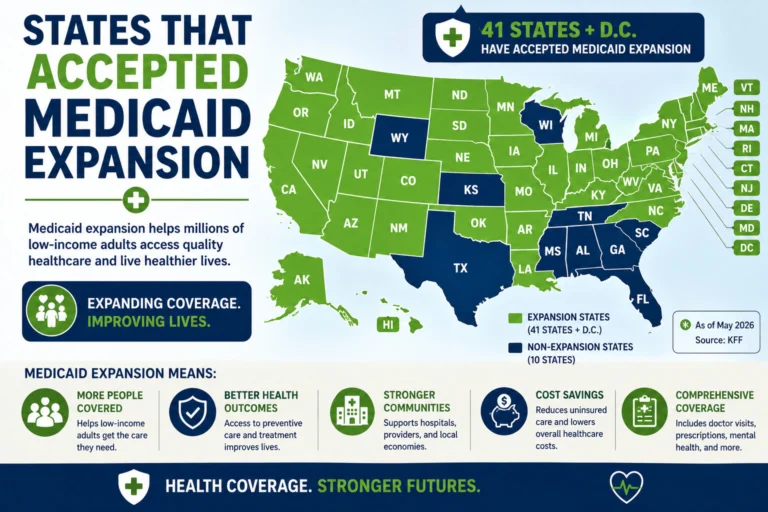
As of May 2026, 41 states, including the District of Columbia, have adopted the ACA Medicaid expansion, while 10 states have not adopted it.
Medicaid expansion does not work exactly the same way in every state. Some states use traditional expansion, while others have implemented approved waivers or other state-specific approaches.
This guide provides a state-by-state overview of Medicaid expansion and explains what expansion can mean for eligible adults.
What Is Medicaid Expansion?
Medicaid expansion refers to the ACA provision that allows states to extend Medicaid eligibility to most adults with household incomes up to 138% of the federal poverty level.
The federal government provides an enhanced federal matching rate for the expansion population. States that adopted the expansion generally receive a 90% federal matching rate for covered expansion adults, subject to federal rules.
The Supreme Court’s 2012 decision made Medicaid expansion effectively optional for states. As a result, some states adopted the expansion quickly, while others waited several years or have not adopted it.
Which States Accepted Medicaid Expansion?
As of May 2026, the following 41 states, including Washington, D.C., have adopted Medicaid expansion:
| State | Expansion Start Date |
|---|---|
| Alaska | September 1, 2015 |
| Arizona | January 1, 2014 |
| Arkansas | January 1, 2014 |
| California | January 1, 2014 |
| Colorado | January 1, 2014 |
| Connecticut | January 1, 2014 |
| Delaware | January 1, 2014 |
| District of Columbia | January 1, 2014 |
| Hawaii | January 1, 2014 |
| Idaho | January 1, 2020 |
| Illinois | January 1, 2014 |
| Indiana | February 1, 2015 |
| Iowa | January 1, 2014 |
| Kentucky | January 1, 2014 |
| Louisiana | July 1, 2016 |
| Maine | January 10, 2019 |
| Maryland | January 1, 2014 |
| Massachusetts | January 1, 2014 |
| Michigan | April 1, 2014 |
| Minnesota | January 1, 2014 |
| Missouri | October 1, 2021 |
| Montana | January 1, 2016 |
| Nebraska | October 1, 2020 |
| Nevada | January 1, 2014 |
| New Hampshire | August 15, 2014 |
| New Jersey | January 1, 2014 |
| New Mexico | January 1, 2014 |
| New York | January 1, 2014 |
| North Carolina | December 1, 2023 |
| North Dakota | January 1, 2014 |
| Ohio | January 1, 2014 |
| Oklahoma | July 1, 2021 |
| Oregon | January 1, 2014 |
| Pennsylvania | January 1, 2015 |
| Rhode Island | January 1, 2014 |
| South Dakota | July 1, 2023 |
| Utah | January 1, 2020 |
| Vermont | January 1, 2014 |
| Virginia | January 1, 2019 |
| Washington | January 1, 2014 |
| West Virginia | January 1, 2014 |
The District of Columbia is included in the 41 jurisdictions counted by KFF even though it is not a state.
States That Have Not Accepted Medicaid Expansion
As of May 2026, 10 states have not adopted the ACA Medicaid expansion:
- Alabama
- Florida
- Georgia
- Kansas
- Mississippi
- South Carolina
- Tennessee
- Texas
- Wisconsin
- Wyoming
Not expanding Medicaid does not mean residents of these states cannot qualify for Medicaid. States still operate Medicaid programs with eligibility categories that existed before the ACA expansion.
However, eligibility for low-income adults can differ substantially between expansion and non-expansion states.
Medicaid Expansion States by Region
Looking at the expansion map by region can make it easier to understand where Medicaid expansion is available.
Western States
Several Western states have adopted Medicaid expansion, including:
- Alaska
- Arizona
- California
- Colorado
- Hawaii
- Idaho
- Montana
- Nevada
- New Mexico
- Oregon
- Utah
- Washington
Midwestern States
Expansion states in the Midwest include:
- Illinois
- Indiana
- Iowa
- Michigan
- Minnesota
- Nebraska
- North Dakota
- Ohio
Wisconsin has not adopted the ACA expansion.
Southern States
Several Southern states have expanded Medicaid, including:
- Arkansas
- Kentucky
- Louisiana
- Maryland
- Missouri
- North Carolina
- Oklahoma
- Virginia
- West Virginia
However, several Southern states have not adopted the expansion, including Alabama, Florida, Georgia, Mississippi, South Carolina, Tennessee, and Texas.
Northeastern States
Northeastern states that adopted Medicaid expansion include:
- Connecticut
- Delaware
- Maine
- Massachusetts
- New Hampshire
- New Jersey
- New York
- Pennsylvania
- Rhode Island
- Vermont
When Did States Begin Expanding Medicaid?
The first major group of states implemented Medicaid expansion in January 2014, when the ACA expansion took effect.
Other states adopted expansion later.
For example:
- Alaska implemented expansion in 2015.
- Louisiana implemented expansion in 2016.
- Montana implemented expansion in 2016.
- Virginia implemented expansion in 2019.
- Maine implemented expansion in 2019.
- Idaho, Nebraska, and Utah implemented expansion in 2020.
- Missouri and Oklahoma implemented expansion in 2021.
- South Dakota implemented expansion in 2023.
- North Carolina implemented expansion in December 2023.
This gradual adoption explains why Medicaid eligibility differs from one state to another.
How Does Medicaid Expansion Work?
Before the ACA, Medicaid eligibility for adults was generally based on specific categories such as disability, pregnancy, being a parent, or meeting other state-defined requirements.
Medicaid expansion created a broader eligibility pathway for adults.
In expansion states, adults who meet the applicable requirements can generally qualify based on income if they fall within the expansion income limit.
The ACA expansion generally covers adults ages 19 through 64 with incomes up to 138% of the federal poverty level, although specific eligibility rules and enrollment procedures vary by state.
Who Can Qualify for Medicaid Expansion?
Medicaid expansion primarily provides coverage to low-income adults who previously may not have qualified for Medicaid.
Eligibility can depend on:
- Household income
- Household size
- Age
- Residency
- Immigration status
- Other federal and state requirements
Income limits are generally calculated using Modified Adjusted Gross Income (MAGI) for the expansion population.
Having a job does not automatically disqualify someone from Medicaid expansion. Eligibility is primarily based on income and other program requirements.
What Does Medicaid Expansion Cover?
Medicaid coverage varies by state, but beneficiaries can generally receive comprehensive healthcare benefits.
Depending on the state and plan, covered services can include:
- Doctor visits
- Hospital care
- Preventive care
- Prescription medications
- Laboratory services
- Mental health services
- Substance use disorder treatment
- Emergency care
- Maternity services
- Specialist care
- Preventive screenings
People should review their state’s Medicaid program and individual health plan for specific benefits.
Why Did States Adopt Medicaid Expansion?
States have adopted Medicaid expansion for several reasons.
Increased Health Coverage
Expansion allows more low-income adults to qualify for Medicaid coverage.
KFF estimates that approximately 20 million people were enrolled through the Medicaid expansion group in 2025.
Reduced Uninsured Rates
Medicaid expansion has helped reduce the number of uninsured adults, particularly among lower-income populations.
Federal Funding
Expansion states receive an enhanced federal matching rate for the expansion population.
Support for Healthcare Providers
Expanded coverage can help healthcare providers receive payment for services delivered to previously uninsured patients.
Research has also found benefits for healthcare providers, including rural hospitals, in states that expanded Medicaid.
What Happens in States That Did Not Expand Medicaid?
Residents of non-expansion states may face different Medicaid eligibility rules.
In some cases, low-income adults without dependent children may not qualify for Medicaid based solely on income.
This can create what is commonly called the Medicaid coverage gap.
People in the coverage gap may have incomes that are too high for their state’s traditional Medicaid eligibility rules but too low to qualify for certain ACA Marketplace financial assistance.
KFF estimates that about 1.2 million uninsured people remain in the coverage gap across the 10 non-expansion states.
Medicaid Expansion and the 2026–2027 Changes
Medicaid expansion remains an important part of the U.S. healthcare system, but federal policy changes may affect how expansion coverage operates.
The 2025 federal reconciliation law includes new Medicaid work requirements affecting many adults enrolled through the ACA expansion pathway. States subject to the requirements must begin implementation by January 1, 2027, although some states may implement them earlier.
Because implementation is ongoing, Medicaid members should regularly check their state’s Medicaid website and health plan communications for updated eligibility and renewal information.
How to Apply for Medicaid in an Expansion State
If you live in a Medicaid expansion state, you can generally apply through your state’s Medicaid agency or the federal Marketplace, depending on your state’s enrollment system.
Before applying, prepare information such as:
- Household income
- Household size
- Social Security numbers, when applicable
- Proof of identity
- State residency information
- Immigration documentation, when applicable
The application process varies by state.
How to Check If Your State Expanded Medicaid
If you’re unsure whether your state expanded Medicaid, check your state’s Medicaid agency or a current state-by-state Medicaid expansion resource.
The status can change, so older articles and social media posts may not reflect the latest information.
As of May 2026, KFF reports 41 states including Washington, D.C., have adopted Medicaid expansion and 10 have not.
Frequently Asked Questions
How many states accepted Medicaid expansion?
As of May 2026, 41 states including the District of Columbia have adopted the ACA Medicaid expansion. Ten states have not adopted it.
Which states have not expanded Medicaid?
The 10 non-expansion states are Alabama, Florida, Georgia, Kansas, Mississippi, South Carolina, Tennessee, Texas, Wisconsin, and Wyoming.
What income qualifies for Medicaid expansion?
The ACA expansion generally covers adults with incomes up to 138% of the federal poverty level, although eligibility rules and application procedures can vary by state.
Is Medicaid expansion available in every state?
No. As of May 2026, 41 states including Washington, D.C. have adopted the expansion, while 10 states have not.
Can I qualify for Medicaid if I work?
Yes. Working does not automatically prevent someone from qualifying for Medicaid. In expansion states, income and other eligibility requirements determine whether an adult qualifies.
Does Medicaid expansion cover children?
Medicaid expansion primarily created a new eligibility pathway for adults. Children were already covered through Medicaid and CHIP under separate eligibility rules.
Can Medicaid expansion rules change?
Yes. Federal and state Medicaid policies can change. Members should check their state Medicaid agency and health plan for current eligibility, renewal, and work-requirement information.
Final Thoughts
Knowing which states accepted Medicaid expansion can help individuals understand whether they may qualify for affordable healthcare coverage. As of May 2026, 41 states, including the District of Columbia, have adopted the ACA Medicaid expansion, while 10 states continue to operate without the ACA expansion pathway.
Expansion generally provides a pathway for eligible low-income adults to obtain Medicaid coverage based primarily on income. However, eligibility, benefits, enrollment procedures, and future policy requirements can vary by state.
If you are considering applying for Medicaid, check your state’s official Medicaid agency for the most current eligibility rules and application information rather than relying solely on general national guidelines.