
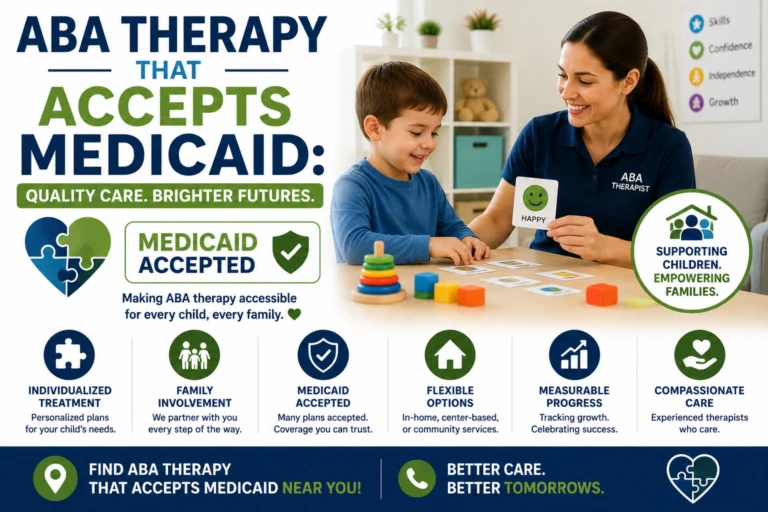
Meta Title: ABA Therapy That Accepts Medicaid | Find Affordable ABA Services
Meta Description: Looking for ABA therapy that accepts Medicaid? Learn how to find Medicaid-approved ABA providers, understand coverage, check eligibility, and prepare for ABA therapy services.
ABA Therapy That Accepts Medicaid
Finding ABA therapy that accepts Medicaid can be an important step for families seeking behavioral and developmental support for a child with autism spectrum disorder (ASD).
Applied Behavior Analysis, commonly called ABA therapy, is one approach used to support people with autism and other developmental or behavioral needs. Medicaid programs can provide autism-related services through several benefit categories, and eligible children may receive medically necessary services under the federal Early and Periodic Screening, Diagnostic, and Treatment (EPSDT) benefit. However, the exact services, provider requirements, authorization rules, and coverage limits vary by state and Medicaid plan.
If you are searching for an ABA therapist near me that accepts Medicaid, this guide explains how to find providers, verify insurance coverage, understand the enrollment process, and choose an appropriate ABA therapy provider.
What Is ABA Therapy?
Applied Behavior Analysis is a structured approach that uses principles of learning and behavior to support specific skills and reduce behaviors that interfere with daily life.
ABA programs can be individualized based on a person’s needs and goals.
Depending on the treatment plan, ABA services may focus on areas such as:
- Communication skills
- Social skills
- Daily living skills
- Self-care
- Learning skills
- Following instructions
- Coping and emotional regulation
- Reducing behaviors that interfere with learning or safety
- Increasing independence
The specific goals and methods used should be determined by qualified professionals based on an individual’s needs.
Does Medicaid Cover ABA Therapy?
Medicaid can cover autism-related treatment and intervention services, but coverage is not identical in every state.
CMS explains that ABA is one treatment modality for autism and that state Medicaid agencies determine which services are medically necessary for eligible beneficiaries. For children under age 21, EPSDT requires Medicaid programs to provide medically necessary services within covered benefit categories to correct or ameliorate identified conditions.
This means families should not assume that every Medicaid plan has the same ABA benefits.
Before starting treatment, confirm:
- Whether ABA is covered
- Whether your provider participates in your Medicaid plan
- Whether prior authorization is required
- Whether an autism diagnosis is required
- What documentation is needed
- Whether there are limits on treatment hours
- Whether a treatment plan must be approved
- Whether there are age requirements
- Whether there are location or service-setting requirements
How to Find ABA Therapy That Accepts Medicaid
If you are searching for ABA therapy that accepts Medicaid near me, these steps can help.
1. Check Your Medicaid Provider Directory
Start with your state’s Medicaid provider directory or your Medicaid managed care plan’s provider search tool.
Search for terms such as:
- ABA therapy
- Applied Behavior Analysis
- Behavioral health
- Autism services
- Behavioral treatment
- Autism treatment provider
Enter your ZIP code to find providers in your area.
2. Call Your Medicaid Health Plan
The phone number on your Medicaid insurance card can be one of the best resources for finding participating providers.
Ask:
“Can you give me a list of ABA therapy providers that accept my Medicaid plan?”
Also ask whether the provider needs to be approved by the plan before treatment begins.
3. Contact ABA Providers Directly
Even if an ABA provider appears in your Medicaid directory, call the office to confirm current participation.
Ask:
- Do you accept my specific Medicaid plan?
- Are you accepting new patients?
- Do you provide in-home ABA?
- Do you offer clinic-based ABA?
- Do you provide school or community-based services?
- Do you have a waiting list?
- Do you help with insurance authorization?
Provider participation can change, so direct confirmation is important.
4. Ask Your Child’s Pediatrician
A pediatrician or other healthcare provider may be able to help identify autism service providers and provide referrals or documentation if required by your Medicaid plan.
5. Contact Local Autism and Developmental Services
Local developmental disability organizations, community health centers, and autism service organizations may also help families identify potential providers.
What Does a Medicaid ABA Provider Do?
An ABA provider develops and delivers individualized behavioral services based on an assessment and treatment plan.
Depending on the provider and plan, services may involve:
- Behavioral assessments
- Individualized treatment planning
- Direct ABA therapy
- Parent or caregiver training
- Progress monitoring
- Skill development
- Behavior support
- Coordination with other providers
The exact services available depend on the provider’s qualifications and your Medicaid program.
Who Provides ABA Therapy?
ABA services may involve several professionals and support staff.
A treatment team can include:
Board Certified Behavior Analyst (BCBA)
A BCBA may conduct assessments, develop treatment plans, supervise services, analyze progress, and train caregivers or other staff.
Registered Behavior Technician (RBT)
An RBT may provide direct behavioral services under the supervision of a qualified professional.
Other Qualified Professionals
Depending on the state and treatment program, other licensed or credentialed professionals may participate in assessment, treatment, care coordination, or related services.
Always ask the provider who will work directly with your child and who will supervise the treatment.
What Can ABA Therapy Help With?
ABA programs can be designed around individualized goals.
Examples may include:
- Improving communication
- Developing social interaction skills
- Learning new daily routines
- Increasing independence
- Improving attention and learning behaviors
- Developing self-care skills
- Supporting appropriate communication of needs
- Reducing behaviors that interfere with daily activities
ABA should be individualized rather than using exactly the same approach for every child.
How Much Does ABA Therapy Cost With Medicaid?
The cost of ABA therapy depends on the state, Medicaid plan, provider, treatment plan, and authorization requirements.
When a provider is participating and the service is covered, Medicaid may pay some or all of the approved cost according to the plan’s rules.
Before beginning services, ask:
- Is ABA covered by my plan?
- Is the provider in-network?
- Is there a copayment?
- Is prior authorization required?
- How many hours are authorized?
- Are there annual or service limits?
- What happens if additional hours are medically necessary?
Getting these details in writing can help families avoid unexpected bills.
Does Medicaid Require an Autism Diagnosis for ABA Therapy?
Requirements can vary by state and Medicaid program.
Some programs may require an autism diagnosis or other clinical documentation before authorizing certain autism-related services. However, federal EPSDT rules do not establish a universal requirement that every child must have a formal diagnosis before receiving every EPSDT service; states determine medical-necessity criteria.
If you are unsure what documentation is needed, contact your Medicaid plan before beginning the evaluation process.
Does ABA Therapy Require Prior Authorization?
Many Medicaid programs and managed care plans may require prior authorization for ABA services.
Authorization may involve:
- Diagnostic documentation
- Behavioral assessments
- Treatment goals
- Recommended number of hours
- Provider credentials
- Treatment plans
- Progress reports
Authorization rules vary by state and plan.
Ask your Medicaid plan:
“What authorization do I need before my child starts ABA therapy?”
How Long Does It Take to Start ABA Therapy?
The timeline can vary significantly.
Some families may begin after completing an evaluation and receiving authorization, while others may face provider shortages or waiting lists.
Possible steps include:
- Contacting Medicaid
- Finding participating providers
- Completing an intake
- Obtaining required evaluations
- Developing a treatment plan
- Submitting authorization paperwork
- Waiting for approval
- Scheduling therapy
If your preferred provider has a waiting list, ask whether the office can recommend another participating provider.
Types of ABA Therapy Settings
ABA services may be provided in different settings depending on the provider and Medicaid program.
In-Home ABA Therapy
A therapist may provide services in the child’s home.
This setting can allow treatment to focus on skills used during everyday routines.
Clinic-Based ABA Therapy
Some providers operate dedicated behavioral therapy clinics.
Clinic-based services may offer structured environments and access to treatment staff.
School-Based Services
Certain Medicaid-covered services may be provided in school settings when they meet applicable Medicaid requirements. However, school services and community ABA services can have different billing and coverage rules. CMS notes that states have processes to prevent duplicate payment when services overlap.
Community-Based ABA
Some providers offer services in community environments where children can practice skills in everyday situations.
How to Choose an ABA Provider That Accepts Medicaid
Insurance participation is important, but it should not be the only factor.
Consider:
Experience
Ask about the provider’s experience working with children with similar needs.
Credentials
Ask who will assess your child, create the treatment plan, supervise therapy, and provide direct services.
Treatment Approach
Ask how the provider develops individualized goals and measures progress.
Family Involvement
Ask whether parents and caregivers receive training and guidance.
Communication
Find out how frequently the provider communicates with families about progress.
Location
Consider whether the provider offers in-home, clinic, school, or community services.
Availability
Ask how quickly services can begin and whether there is a waiting list.
Questions to Ask an ABA Provider
Before choosing a provider, consider asking:
- Do you accept my Medicaid plan?
- Are you accepting new patients?
- Do you have a waiting list?
- What ages do you serve?
- What areas do you serve?
- Do you provide in-home ABA?
- Do you offer clinic-based services?
- Who supervises the treatment?
- How is the treatment plan developed?
- How is progress measured?
- Do you provide caregiver training?
- Do you help with Medicaid authorization?
- How many therapy hours are typically requested?
- What happens if Medicaid does not approve the requested services?
These questions can help families compare providers before committing to treatment.
What Documents May Be Needed?
Depending on your Medicaid plan and provider, you may be asked for:
- Medicaid insurance card
- Identification
- Autism evaluation or diagnostic records
- Medical records
- Referral documents
- Behavioral assessments
- Treatment plans
- Previous therapy records
- School or developmental records
The provider or Medicaid plan should tell you which documents are actually required.
What If You Can’t Find ABA Therapy That Accepts Medicaid?
Finding an available Medicaid ABA provider can sometimes be challenging.
If you cannot find one nearby, consider:
- Calling your Medicaid health plan
- Asking for additional participating providers
- Searching neighboring ZIP codes
- Asking about telehealth or caregiver-support options when appropriate
- Contacting community autism organizations
- Asking your pediatrician for referrals
- Checking local developmental disability resources
- Asking providers about cancellation lists
If your Medicaid plan cannot help you locate an available provider, ask Member Services what process is available for obtaining assistance with access to covered care.
Medicaid ABA Therapy for Children Under 21
Children and adolescents enrolled in Medicaid receive important protections through the EPSDT benefit.
CMS explains that EPSDT generally requires Medicaid programs to provide medically necessary services for eligible children and adolescents that fall within Medicaid-covered benefit categories and are needed to correct or ameliorate identified conditions.
This is particularly relevant for families seeking autism-related services.
However, EPSDT does not mean every specific therapy is automatically approved. The state Medicaid agency and health plan determine applicable medical-necessity and authorization requirements.
Can Adults Get ABA Therapy Through Medicaid?
ABA and other autism-related services can also be available to adults in some Medicaid programs, but coverage for adults may differ from coverage available to children.
CMS explains that states have multiple options for providing autism services through Medicaid. Coverage beyond the EPSDT age group can depend on state plan benefits, waivers, and other program rules.
Adults should contact their state Medicaid program or health plan to determine which autism-related services are available.
Frequently Asked Questions
Does Medicaid pay for ABA therapy?
Medicaid can cover autism-related services, including services that may involve ABA, depending on state rules, medical necessity, and the member’s specific plan. Coverage is not identical nationwide.
How do I find ABA therapy that accepts Medicaid near me?
Contact your Medicaid health plan, use its provider directory, and call ABA providers directly to confirm that they accept your specific Medicaid plan and are accepting new patients.
Is ABA therapy free with Medicaid?
Not necessarily. Covered services may have limited or no cost-sharing depending on the Medicaid program, but families should confirm their specific benefits and any applicable costs before treatment.
Does Medicaid cover ABA for autism?
Medicaid provides states with multiple options for covering autism-related services. For eligible children, EPSDT provides coverage for medically necessary services within applicable benefit categories.
Do I need a referral for ABA therapy?
Some Medicaid plans or providers may require a referral, evaluation, or other documentation. Requirements vary by state and plan.
How long is the ABA therapy waiting list?
There is no single nationwide waiting period. Availability depends on the provider, location, staffing, and demand for services.
Can ABA therapy be provided at home?
Some providers offer in-home ABA therapy, but availability depends on the provider, treatment plan, and Medicaid coverage rules.
Final Thoughts
Finding ABA therapy that accepts Medicaid can take time, but families have several ways to locate participating providers. Start by contacting your Medicaid health plan, checking the provider directory, and calling ABA clinics directly to verify current participation.
Medicaid coverage for autism services varies by state and plan. For children under 21, the EPSDT benefit can provide important access to medically necessary services, while states determine specific medical-necessity and coverage requirements.
Before starting therapy, confirm your benefits, provider participation, authorization requirements, and any potential costs. Comparing providers based on credentials, treatment approach, availability, location, and family involvement can help you find an ABA program that fits your child’s individual needs.