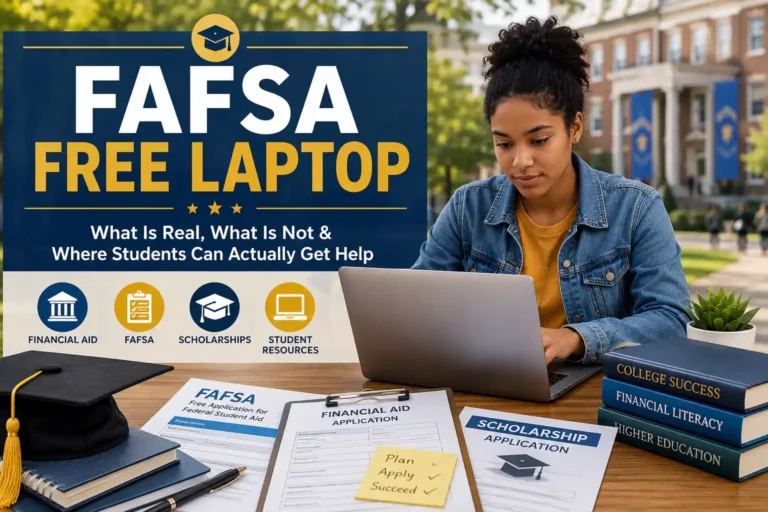
Many students search for a FAFSA free laptop because they need a computer to keep up with classes, homework, online portals, and job applications. The problem is that the phrase itself can be misleading. FAFSA does not hand out laptops as a direct federal benefit. What it does do is help determine eligibility for federal grants, work-study funds, and student loans, and schools, states, and some private aid providers also use FAFSA information when deciding who gets aid.
That is why the smartest approach is not to look for a “FAFSA laptop program” in the narrow sense. It is to understand how FAFSA can help you qualify for school aid, then check whether your college offers laptop loans, emergency tech support, or need-based device programs. Some schools do exactly that. For example, the University of Wisconsin-Milwaukee says its laptop loan program is meant to help students through a short-term emergency and requires demonstrated financial need. SUNY Empire’s laptop loan program gives priority to students with low FAFSA-related need indicators, and Vanderbilt’s School of Engineering offers a laptop loaner program for students with demonstrated financial need.
What FAFSA actually does
FAFSA is the free form students complete to access federal student aid. The U.S. Department of Education says that submitting the FAFSA gives students access to federal grants, work-study funds, and federal student loans, and the same FAFSA information can also be used by states and schools to determine eligibility for additional aid.
That matters because a student who qualifies for aid may also qualify for other forms of support through the school, such as scholarships, emergency assistance, or device-loan programs. The FAFSA itself is not the laptop, but it can open the door to the aid office that may help you get one.
Who may have the best chance of getting a laptop
Students with documented financial need usually have the strongest chance of getting help. That is the pattern shown by official laptop-loan programs at several schools. UWM prioritizes students who can show financial need and have exhausted other resources. SUNY Empire gives priority to students with low FAFSA-based need indicators or who receive Pell or TAP grants. Vanderbilt’s engineering school serves students with demonstrated financial need.
In practical terms, students who are low-income, Pell-eligible, or facing a short-term emergency should start with the financial aid office, student affairs office, or library technology desk at their school. Many campuses keep their laptop supply limited, so approval is never guaranteed. UWM and the University at Buffalo both note that laptop availability is limited, and Buffalo says fewer laptops are available as its program retires.
Where students can look for a real laptop program
The most reliable places to check are:
Your school’s financial aid office
Your campus dean of students office
Your university library or IT services team
Your scholarship or emergency grant office
These are the departments most likely to know whether a loaner laptop program exists, whether it is need-based, and whether it is temporary or long term. UWM runs its program through the Dean of Students Office, SUNY Empire lists laptop loans through student affairs, and Vanderbilt lists its laptop loaner program through financial aid.
How to apply the right way
The FAFSA should still be your first step if you need aid for school. Federal Student Aid says the FAFSA form is completed at fafsa.gov and that you may need your StudentAid.gov account, tax information, asset records, and a list of schools you are interested in attending. After submission, the Department of Education advises students to review their FAFSA Submission Summary, make corrections if needed, complete any state aid applications, and compare school aid offers.
Once that is done, contact your school and ask a direct question: Does your college offer a laptop loan, emergency technology grant, or device assistance program for students with financial need? That question is much more effective than asking whether FAFSA itself gives out laptops, because the laptop help is usually school-based, not federal. The official school examples above show that need-based laptop help is real, but it is administered by the institution, not by FAFSA.
What to avoid
Be careful with pages or social media posts that promise a guaranteed free laptop “through FAFSA.” That wording is usually too broad. FAFSA is an aid application, not a direct device giveaway. Federal Student Aid says completing FAFSA is free and is used to determine aid eligibility, but it does not describe a federal laptop benefit.
You should also be careful with any offer that asks for upfront payment, shipping fees, or personal information before there is a real application process. Legitimate school programs usually have a formal application, limited inventory, and clear eligibility rules. The official programs from UWM, SUNY Empire, and Vanderbilt all describe specific eligibility standards and limited availability.
Best answer in one line
If you are looking for a FAFSA free laptop, the real path is this: submit FAFSA, check your aid eligibility, then ask your college about loaner laptops or emergency tech programs. FAFSA helps determine aid. The laptop usually comes from the school.
FAQ
Does FAFSA give free laptops?
No direct federal laptop benefit is listed by Federal Student Aid. FAFSA is used to determine eligibility for grants, work-study, loans, and other aid.
Can FAFSA help me get a laptop?
Yes, indirectly. Some schools use FAFSA-based need information to prioritize laptop loans or emergency technology support.
Which students are most likely to qualify?
Students with financial need, Pell-eligible students, and students facing emergencies are often prioritized in school laptop programs.
Where should I apply?
Start with FAFSA at fafsa.gov, then contact your school’s financial aid office or student support office about laptop assistance.