
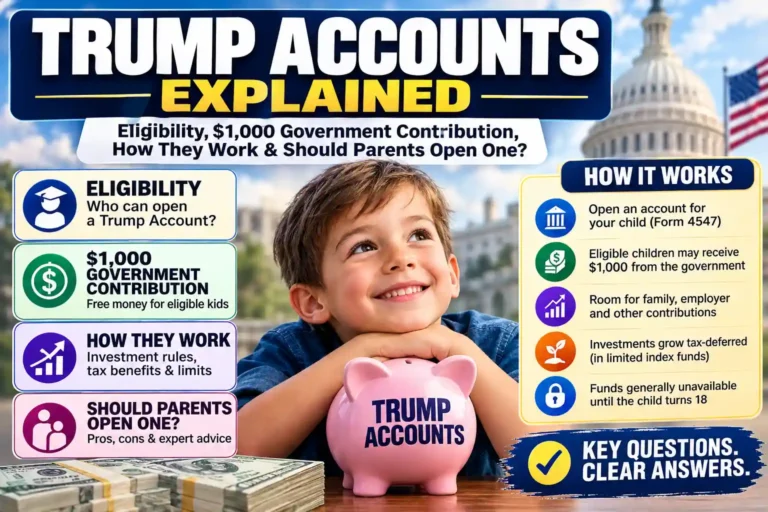
For years, parents looking to save for a child’s future have relied on 529 college savings plans, custodial accounts, and traditional investment accounts. A new option—called a Trump Account under federal law—has now joined that list.
Since the program was announced, thousands of parents have searched for answers such as:
- What is a Trump Account?
- Who qualifies?
- Does every child receive $1,000?
- How do I open one?
- Is it better than a 529 plan?
- Are Trump Accounts available now?
Some information circulating online is incomplete or inaccurate. In this guide, we’ll explain how the program works using current IRS guidance while also discussing its potential advantages and limitations. We’ll compare it with other savings options so parents can make informed decisions instead of relying on social media rumors.
What Is a Trump Account?
A Trump Account is a tax-advantaged investment account created under federal law to help children begin investing early in life.
Unlike a checking or savings account, money placed in a Trump Account is invested in qualified stock index funds designed to track the broader U.S. market rather than being held as cash. The goal is long-term growth rather than short-term spending.
Parents, grandparents, employers, and certain organizations may contribute to these accounts within annual contribution limits established by law.
For eligible children, the federal government may also make a one-time $1,000 pilot program contribution, but that benefit is not available to every child. Eligibility depends on specific statutory requirements.
Why Were Trump Accounts Created?
The idea behind the program is simple:
Children who begin investing at a very young age have decades for compound growth to work in their favor.
Instead of waiting until adulthood to start saving, lawmakers designed Trump Accounts to encourage families to build long-term assets beginning in childhood.
Supporters believe the accounts can:
- encourage long-term investing,
- help families accumulate wealth over time,
- promote financial literacy,
- supplement—not replace—other savings strategies.
Critics, however, note that contribution limits, withdrawal rules, and tax treatment differ from more established options like 529 plans or Roth IRAs, so families should compare accounts before deciding where to save.
How Do Trump Accounts Work?
Although they are often described as “accounts for kids,” they function more like a long-term investment account than a traditional bank account.
Here’s the basic process:
- An authorized adult opens the account.
- The child becomes the beneficiary.
- Contributions are invested in eligible broad-market index funds.
- Investments can grow over many years.
- Withdrawals generally cannot occur before the child reaches adulthood, except in limited situations defined by law. After that, the account is generally treated similarly to a traditional IRA for tax purposes.
Key Features
Some of the program’s most important features include:
| Feature | Details |
|---|---|
| Beneficiary | Eligible child |
| Investment | Qualified index mutual funds or ETFs |
| Annual family contribution limit | Up to $5,000 (subject to future inflation adjustments) |
| Employer contribution | Up to $2,500 annually, counting toward the overall limit |
| Government contribution | One-time $1,000 for qualifying children under the pilot program |
| Early withdrawals | Generally not allowed before adulthood, except as provided by law |
These rules come from current IRS guidance and may be refined through future regulations.
Who Is Eligible?
Not every child automatically qualifies.
Generally, an eligible child must:
- have a valid Social Security number,
- be under age 18 at the end of the calendar year the election is made, and
- have an account established by an authorized individual, such as a parent or legal guardian.
Eligibility for opening an account is broader than eligibility for the federal $1,000 contribution.
Which Children Receive the $1,000 Government Contribution?
This is the most misunderstood part of the program.
Under current IRS guidance, the federal government’s one-time $1,000 pilot contribution is generally available only for children who:
- are U.S. citizens,
- are born on or after January 1, 2025, through December 31, 2028, and
- have a proper election made for the account.
That means:
- Children born before 2025 generally do not qualify for the federal $1,000 pilot contribution under current law.
- Older children may still be eligible to have a Trump Account opened if they otherwise meet the statutory requirements, but they would not receive the pilot deposit solely because an account exists.
Is Every Child Automatically Enrolled?
No.
Parents should not assume the government automatically creates an account for every eligible child.
Current IRS guidance explains that an authorized individual must make an election—either through IRS Form 4547 or the approved online process—to establish the account and, where applicable, request the pilot contribution.
Can Family Members Contribute?
Yes.
Beyond the government’s one-time pilot contribution (for eligible children), contributions may come from:
- parents,
- grandparents,
- relatives,
- friends,
- employers (through qualifying employer programs), and
- certain charitable or governmental entities under specific rules.
These contributions are subject to statutory annual limits and reporting requirements.
How to Open a Trump Account, IRS Form 4547, Contribution Limits & Private Funding
Now that you understand what a Trump Account is and who may qualify, the next step is learning how the enrollment process works.
Although the program is relatively new, the IRS has already released guidance explaining how parents and other authorized individuals can establish an account and, when eligible, request the government’s one-time $1,000 pilot contribution.
When Can You Open a Trump Account?
Trump Accounts officially became available in 2026.
According to the IRS, elections to establish an account can be made before the calendar year in which the child turns 18. However, contributions cannot be deposited before July 4, 2026, which marks the operational launch of the program.
That means parents may complete the required election before making contributions, but funding follows the dates established under federal law.
How to Open a Trump Account
The IRS has created a straightforward enrollment process that generally takes only a few minutes if you already have the required information.
Step 1: Sign in to Your IRS Online Account
Parents or another authorized individual begin by signing in to an IRS Individual Online Account using ID.me verification.
If you don’t already have an account, you’ll need to create one first.
Step 2: Complete Form 4547
The next step is submitting IRS Form 4547, officially titled Trump Account Election(s).
This form is used to:
- establish the child’s initial Trump Account,
- elect participation in the program,
- request the one-time $1,000 pilot contribution when the child qualifies.
Step 3: Submit the Election
Parents generally have several options:
- Submit Form 4547 electronically through an IRS Online Account.
- Include it with an eligible electronic tax return when available.
- Mail a paper form to the IRS if required.
Electronic filing is expected to be the fastest option because it also allows applicants to monitor processing.
Step 4: Track Your Status
After submission, the IRS Online Account allows users to check:
- election status,
- processing updates,
- whether additional information is needed.
What Information Will You Need?
Before beginning the application, gather:
- Child’s Social Security number
- Child’s date of birth
- Child’s residential address
- IRS Online Account (ID.me)
- Parent or authorized individual’s identifying information
Having these details ready can make the application much smoother.
Who Can File Form 4547?
Not everyone can establish a Trump Account.
The IRS refers to the filer as an authorized individual.
Depending on the circumstances, this may include:
- Parent
- Legal guardian
- Adult sibling
- Grandparent
When requesting the federal $1,000 pilot contribution, additional eligibility requirements apply regarding who may submit the election.
Understanding IRS Form 4547
Although many online discussions describe Form 4547 as an application, it is technically an election form.
Its primary purposes are to:
- establish an initial Trump Account,
- identify the eligible child,
- request the pilot contribution if applicable.
The IRS may issue updated instructions as the program evolves, so applicants should always use the latest version of the form.
How Much Can Families Contribute?
Federal law establishes annual contribution limits.
Under current guidance:
| Contribution Type | Annual Limit |
|---|---|
| Family and private contributions | Up to $5,000 |
| Employer contributions | Up to $2,500 (subject to separate rules) |
| Federal pilot contribution | $1,000 (does not count toward the annual limit) |
Beginning in future years, some limits may be adjusted for inflation.
Can Employers Contribute?
Yes.
One unique feature of the program is that employers may contribute to a Trump Account established for an employee or an employee’s dependent.
Current IRS guidance provides:
- Employer contributions are generally limited to $2,500 per year per employee.
- Employer contributions count toward the overall annual contribution rules applicable to the account.
Some companies have also announced voluntary matching or contribution initiatives, but these are employer-specific programs rather than government benefits.
The Michael & Susan Dell Foundation Commitment
One of the largest private commitments announced so far comes from the Michael & Susan Dell Foundation.
The foundation pledged $6.25 billion to support Trump Accounts for up to 25 million children who generally were born before January 1, 2025, meet age requirements, and live in qualifying ZIP codes based on median family income. The program is intended to complement—not replace—the federal pilot contribution for younger eligible children.
Because eligibility depends on the foundation’s announced criteria, families should review the latest details before assuming they qualify.
Can Charities or State Governments Contribute?
Yes.
Federal law also permits certain:
- charitable organizations,
- state governments,
- local governments,
to make qualifying contributions under specific rules.
Unlike ordinary family deposits, some governmental and charitable contributions do not count toward the standard annual contribution limit established for private contributors.
Can You Open an Account for an Older Child?
Yes, in many situations.
A child does not need to be a newborn to have a Trump Account established.
However, parents should distinguish between:
- opening a Trump Account, and
- qualifying for the federal $1,000 pilot contribution.
Children born before January 1, 2025, generally are not eligible for the federal pilot deposit, even though they may still qualify to have an account established if they meet the statutory requirements.
Trump Account vs. 529 Plan, UTMA & Other Savings Options, Tax Benefits, Withdrawal Rules, Pros & Cons
Choosing a savings account for your child isn’t always straightforward. Trump Accounts are one option, but they aren’t designed to replace every existing savings vehicle. Depending on your goals—such as paying for college, helping with a first home, or building retirement savings—another account may be a better fit, or you may benefit from using more than one. Financial planners generally view Trump Accounts as a complement to, rather than a replacement for, established savings tools.
Trump Account vs. 529 Plan
A 529 plan has long been one of the most popular ways to save for education because qualified withdrawals are generally tax-free. Trump Accounts take a different approach by focusing on long-term investing rather than education alone.
| Feature | Trump Account | 529 Plan |
|---|---|---|
| Primary purpose | Long-term wealth building | Education savings |
| Government seed contribution | Eligible children may receive $1,000 | No federal seed contribution |
| Annual family contribution | Generally up to $5,000 | Much higher state plan limits |
| Investment choices | Limited index funds tracking primarily U.S. equities | Broad investment menus |
| Tax treatment | Tax-deferred growth | Tax-free qualified education withdrawals |
| Education only? | No | Primarily yes |
Which is Better?
If your primary goal is paying for college, a 529 plan usually provides stronger education-specific tax advantages because qualified education withdrawals are generally tax-free. Trump Accounts offer more flexibility for future financial goals but do not replace those education benefits.
Trump Account vs. UTMA Account
A Uniform Transfers to Minors Act (UTMA) account allows adults to transfer assets to a child, with the child eventually gaining control at the age set by state law.
Compared with a UTMA:
- Trump Accounts have stricter investment rules.
- UTMAs allow investment in a much wider variety of assets.
- Trump Accounts include special federal rules that don’t apply to UTMA accounts.
- UTMAs generally provide more flexibility before adulthood but fewer program-specific incentives.
Families seeking maximum investment flexibility may prefer a UTMA, while those interested in the federal Trump Account framework may appreciate its structured approach.
Trump Account vs. Custodial Brokerage Account
A standard custodial brokerage account lets families invest in:
- individual stocks,
- bonds,
- ETFs,
- mutual funds,
- dividend-paying companies,
- other investments supported by the brokerage.
Trump Accounts are much more restrictive. Current IRS guidance requires investments to remain in qualifying low-cost index funds that primarily track American equities during the child’s growth period.
For experienced investors who want broad investment choices, a custodial brokerage account may provide greater flexibility.
Trump Account vs. Roth IRA
Many parents ask whether they should simply open a Roth IRA instead.
The two accounts serve different purposes.
A child generally needs earned income to contribute to a Roth IRA. Trump Accounts do not require the child to have earned income, making them available to many younger children who would not otherwise qualify for a Roth IRA.
However, Roth IRAs offer their own advantages, including tax-free qualified withdrawals, which differ from the tax treatment of Trump Accounts.
Tax Benefits
One common misconception is that Trump Accounts are completely tax-free.
Current IRS guidance says otherwise.
Contributions
Family contributions are generally not tax-deductible.
Investment Growth
Money grows on a tax-deferred basis while it remains in the account.
Withdrawals
Once withdrawals become permitted under the law, taxation generally follows rules similar to those for a traditional IRA after the child reaches adulthood.
This differs from a 529 plan, where qualified education withdrawals are generally tax-free.
Investment Rules
Trump Accounts are designed to keep investing simple and low-cost.
Rather than allowing unlimited investment choices, federal law requires investments to remain in qualifying mutual funds or exchange-traded funds that track the S&P 500 or another index composed primarily of U.S. equities.
This approach aims to:
- reduce investment costs,
- encourage diversification,
- avoid speculative investing,
- promote long-term growth.
Withdrawal Rules
Parents should understand that Trump Accounts are not intended for short-term expenses.
According to current IRS guidance:
- Funds generally cannot be withdrawn before January 1 of the year the beneficiary turns 18.
- After that, the account is generally treated like a traditional IRA and becomes subject to the applicable distribution rules.
Because withdrawals are restricted during childhood, families who expect to need the money sooner should consider whether another savings vehicle better matches their goals.
Advantages of Trump Accounts
Some of the program’s strongest features include:
- Eligible newborns may receive a one-time $1,000 federal contribution.
- Encourages investing from an early age.
- Tax-deferred investment growth.
- Family members, employers, and certain organizations may contribute.
- Low-cost index fund investing can reduce fees.
- Can complement other savings strategies rather than replace them.
Potential Drawbacks
Before opening an account, parents should also consider the limitations.
Limited Investment Choices
Families cannot choose individual stocks or actively managed funds. Investments are limited to qualifying index funds.
No Early Access
Money generally remains unavailable until the beneficiary reaches the age specified by law.
Education Tax Benefits Are Different
Families saving primarily for college may find a 529 plan offers more favorable tax treatment for qualified education expenses.
New Program
Because Trump Accounts are new, additional IRS guidance and regulations are expected as implementation continues.
Should Families Choose One Account or Multiple?
Many financial professionals suggest that the decision does not have to be “either-or.”
For example:
- A 529 plan can help cover education expenses.
- A Trump Account may support long-term wealth building.
- A Roth IRA may become useful once the child has earned income.
- A custodial brokerage account can provide broader investment flexibility.
Using multiple accounts—when appropriate and affordable—may allow families to take advantage of the strengths of each rather than relying on a single savings strategy.
Frequently Asked Questions, Common Myths, Scam Warnings & Final Verdict
After the announcement of Trump Accounts, thousands of parents searched online for answers. Unfortunately, social media posts and videos have also spread misinformation, leading many families to believe every child automatically receives money from the government or that enrollment happens without any action.
The following questions address the most common concerns based on current IRS guidance.
Frequently Asked Questions
Are Trump Accounts real?
Yes.
Trump Accounts are a real federal program established under the Working Families Tax Cut provisions. The IRS has released Form 4547, official instructions, and guidance explaining how eligible families can establish an account and, if applicable, request the one-time $1,000 pilot contribution.
Can I open a Trump Account for my child?
In many cases, yes.
An account may generally be established for a child who:
- is under 18 by the end of the year the election is made,
- has a valid Social Security number issued before the election,
- has not already had a Trump Account opened on their behalf.
Does every child receive $1,000?
No.
The one-time federal $1,000 pilot contribution is limited to eligible children who meet the requirements established by law, including being U.S. citizens born during the qualifying period and having a proper election filed by an authorized individual.
Can children born before 2025 receive the federal $1,000?
Generally, no.
Current IRS guidance limits the federal pilot contribution to eligible children born between January 1, 2025, and December 31, 2028.
Children born before 2025 may still qualify to have a Trump Account established if they meet the program rules, but they generally are not eligible for the federal seed contribution.
Can grandparents open a Trump Account?
Yes, but only in certain situations.
If no election for the federal pilot contribution is being made, the IRS provides an order of priority for who may act as the authorized individual:
- Legal guardian
- Parent
- Adult sibling
- Grandparent
If the election includes the $1,000 pilot contribution, additional qualifying-child requirements apply.
Can employers contribute?
Yes.
Federal law allows eligible employer contributions, subject to program limits and IRS rules. Employer contributions are separate from the government’s one-time pilot deposit.
Can I contribute more than the government?
Absolutely.
The federal contribution is only the starting point for eligible children.
Parents, grandparents, relatives, employers, and certain organizations may contribute additional money, subject to annual contribution limits.
Are contributions tax-deductible?
No.
Current IRS guidance states that individual contributions to Trump Accounts are generally not tax-deductible, although investments grow on a tax-deferred basis during the growth period.
Can the money be used before age 18?
Generally, no.
The account is intended for long-term investing, and distributions are generally restricted until January 1 of the year the beneficiary turns 18. After that, most traditional IRA rules apply.
Can I have both a 529 Plan and a Trump Account?
Yes.
Nothing in current federal guidance prevents a family from using multiple savings vehicles if they otherwise qualify.
Many financial professionals suggest evaluating each account based on your goals instead of assuming one account replaces another.
Common Myths
Myth: Every child automatically gets $1,000.
Reality: Eligible families must make an election using Form 4547 or the approved online process. The contribution is not automatic.
Myth: Trump Accounts replace 529 plans.
Reality: They serve different purposes. Many families may benefit from using both, depending on their financial goals.
Myth: You can invest in any stock.
Reality: During the growth period, investments are limited to eligible broad U.S. equity index funds or ETFs that meet federal requirements.
Myth: The money can be withdrawn at any time.
Reality: The program is designed for long-term investing, and withdrawals are generally restricted before the beneficiary reaches the applicable age.
How to Protect Yourself From Scams
Because the program has generated significant public interest, scammers may try to exploit families by promising “guaranteed” government payments.
To protect yourself:
- Use only official IRS resources or trusted financial institutions.
- Never pay someone to “unlock” a Trump Account.
- Do not share your Social Security number or banking information with unknown callers or websites.
- Be cautious of social media posts claiming every child automatically qualifies for free money.
- Verify information through official IRS guidance before submitting personal information.
Is a Trump Account Worth It?
There isn’t a single answer that fits every family.
A Trump Account may be worth considering if you:
- want to start investing early for your child,
- qualify for the federal $1,000 pilot contribution,
- prefer a long-term investment approach,
- are comfortable with restricted withdrawals during childhood.
On the other hand, families whose primary goal is education savings may still find a 529 plan more attractive because of its education-specific tax advantages.
The best choice depends on your child’s age, financial goals, tax situation, and whether you expect to use the money for education, retirement, or broader long-term wealth building.
Final Thoughts
Trump Accounts introduce a new way for families to invest for a child’s future. While the program includes attractive features—such as a potential $1,000 federal pilot contribution, tax-deferred growth, and opportunities for family and employer contributions—it also comes with important rules regarding eligibility, investments, and withdrawals.
Rather than relying on social media rumors, parents should review the official IRS guidance, understand who qualifies, and compare Trump Accounts with other savings options such as 529 plans, custodial accounts, and Roth IRAs before making a decision.
For many households, a Trump Account may become one piece of a broader long-term financial strategy rather than the only account used to build a child’s future savings.