
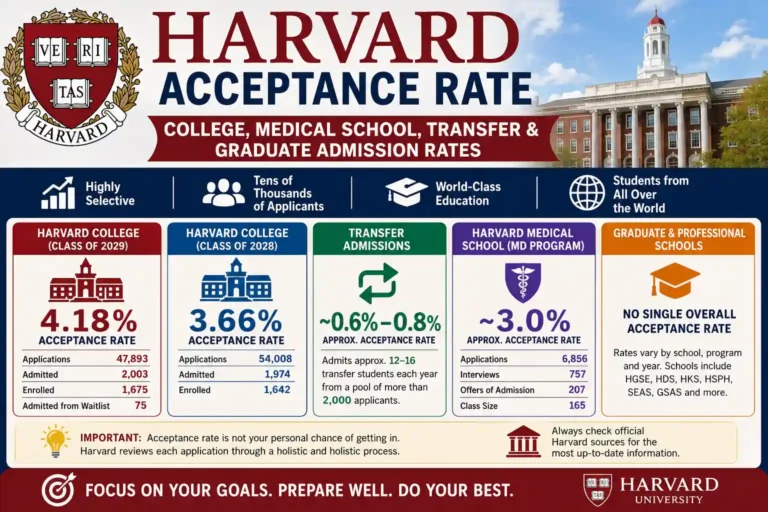
Harvard University is one of the most selective universities in the United States, but there is no single “Harvard acceptance rate” for every program. Harvard College, Harvard Medical School, Harvard Griffin Graduate School of Arts and Sciences, Harvard Graduate School of Education, Harvard Divinity School, Harvard Kennedy School, and Harvard’s other graduate programs each have different admissions processes and applicant pools.
For undergraduate applicants, the latest complete official data currently available are for the Harvard College Class of 2029. Harvard reported 47,893 applicants and 2,003 admitted students, which works out to an acceptance rate of approximately 4.18%. (Harvard College)
The picture is different for transfer applicants and professional or graduate programs. Some Harvard schools publish applications and class sizes but do not publish an official acceptance rate, so it is important not to use an estimated number as though it were an official figure.
What Is Harvard’s Acceptance Rate?
For Harvard College, the latest official acceptance rate is approximately 4.18% for the Class of 2029.
Harvard reported:
| Harvard College Class of 2029 | Number |
|---|---|
| Applications | 47,893 |
| Students admitted | 2,003 |
| Students enrolling | 1,675 |
| Admitted from waitlist | 75 |
| Approx. acceptance rate | 4.18% |
The calculation is:
2,003 ÷ 47,893 × 100 = 4.18%
Harvard’s official admissions statistics page identifies these as the Class of 2029 figures. (Harvard College)
That makes Harvard College’s undergraduate admissions process extremely selective. However, the acceptance rate should not be interpreted as a fixed probability that applies equally to every applicant.
Harvard University Acceptance Rate vs. Harvard College Acceptance Rate
People often use Harvard University acceptance rate and Harvard College acceptance rate interchangeably, but they are not exactly the same thing.
Harvard College is Harvard’s undergraduate school. Its admissions statistics are the figures most people mean when they search for:
- Harvard acceptance rate
- Harvard University acceptance rate
- Harvard College acceptance rate
- Harvard undergraduate acceptance rate
- Harvard undergrad acceptance rate
- What is Harvard’s acceptance rate?
- What is the acceptance rate for Harvard?
- Acceptance rate of Harvard University
Graduate and professional schools at Harvard have separate admissions systems. A Harvard Medical School applicant, for example, is not part of the Harvard College undergraduate admissions pool.
Harvard Acceptance Rate 2025
The phrase Harvard acceptance rate 2025 can refer to different graduating or entering classes, so the class year matters.
For the Class of 2028, Harvard reported 54,008 applications and 1,974 admitted students. That corresponds to approximately 3.66%. (Harvard College)
| Class | Applicants | Admitted | Approx. Acceptance Rate |
|---|---|---|---|
| Class of 2028 | 54,008 | 1,974 | 3.66% |
| Class of 2029 | 47,893 | 2,003 | 4.18% |
The apparent increase from about 3.66% to 4.18% does not mean Harvard became broadly easier to enter. The applicant pool and number admitted changed from one year to the next.
Harvard Acceptance Rate 2026
There is an important distinction between “Harvard acceptance rate 2026” and the latest published acceptance-rate data.
As of August 14, 2026, Harvard’s official admissions statistics page provides the completed Class of 2029 data. Harvard changed its reporting approach beginning with the Class of 2029 and now releases annual admissions information in the fall rather than providing the previous early-action and regular-action breakdowns during the admissions cycle.
Therefore, an article should not present a Class of 2030 acceptance rate as official before Harvard publishes the final annual data.
For now, the safest current answer is:
Harvard College’s latest officially published acceptance rate is approximately 4.18% for the Class of 2029.
Harvard Acceptance Rate 2024
For the Class of 2028, Harvard initially announced that 1,937 students were accepted in March 2024.
Harvard’s later profile of the Class of 2028 reported 1,974 admitted students from 54,008 applicants, after additional admissions activity.
That is why older articles can show different numbers for the same admissions cycle.
When comparing acceptance rates, use the final official class profile where available instead of relying on an early announcement.
Harvard Early Acceptance Rate
Harvard has historically used Restrictive Early Action (REA) rather than binding Early Decision.
That means searches such as:
- Harvard early acceptance rate
- Harvard acceptance rate early decision
- Harvard REA acceptance rate
- Harvard ED acceptance rate
need to be interpreted carefully.
Harvard has changed how it publicly reports undergraduate admissions data. Beginning with the Class of 2029, Harvard says it will provide annual admissions data rather than releasing partial data after early-action and regular-action rounds. The university says the change is intended to provide a more complete and consistent view of the admissions process.
As a result, you should not publish an unofficial early-acceptance percentage as though it were a current Harvard figure.
Harvard REA Acceptance Rate
REA means Restrictive Early Action.
Unlike Early Decision, REA does not require a student to commit to Harvard before receiving an admissions decision.
Harvard’s current reporting policy means that the university no longer publishes the same early-action acceptance statistics it historically released during the admissions cycle.
For students researching Harvard admissions, the final annual class statistics are therefore more useful than trying to estimate a current REA rate.
Harvard Transfer Acceptance Rate
Harvard College transfer admission is considerably more limited than first-year admission.
Harvard says it welcomes approximately 12 transfer students on average each year and receives more than 2,000 transfer applications per year.
Harvard’s transfer admissions FAQ similarly says that in recent years it has admitted 12–16 students from a pool of more than 2,000 applicants.
That means the transfer acceptance rate is roughly around 0.6% to 0.8% when using those recent figures as an approximation.
However, Harvard does not describe that range as a fixed annual acceptance rate.
Why Harvard transfer admission is so selective
Harvard says it looks for:
- A clearly defined academic need to transfer
- A strong academic record at the current institution
- Strong faculty recommendations
- Significant accomplishments and intellectual engagement
- Leadership, creativity, resiliency and intellectual curiosity
Harvard also accepts transfer applicants only for fall admission.
Harvard Medical School Acceptance Rate
Harvard Medical School is separate from Harvard College and has its own admissions process.
For the class entering in 2024, Harvard Medical School reported:
- 6,856 applications
- 757 interviews
- 207 offers of admission
- 165 students in the class
Using applications and offers, the approximate admission rate was:
207 ÷ 6,856 × 100 ≈ 3.02%
So a reasonable description is:
Harvard Medical School’s recent MD admission rate was approximately 3%, based on 207 offers from 6,856 applications for the 2024 entering class.
The current HMS admissions page identifies 6,856 applications and a 165-student class for the Class of 2028, along with an average GPA of 3.9 and average MCAT of 520.42.
Important distinction
Do not confuse:
Harvard College acceptance rate ≠ Harvard Medical School acceptance rate
Harvard College is undergraduate admission, while HMS admission is for medical education.
Harvard Med School Acceptance Rate and Requirements
The Harvard Medical School numbers illustrate how selective medical admission can be.
For its Class of 2028, HMS reports:
| Category | HMS Figure |
|---|---|
| Applications | 6,856 |
| Interviews | 757 |
| Class size | 165 |
| Average GPA | 3.9 |
| Average MCAT | 520.42 |
These statistics should not be treated as minimum requirements. Harvard evaluates applicants using a comprehensive admissions process.
Harvard Graduate School Acceptance Rate
There is no single Harvard graduate school acceptance rate.
Harvard has multiple graduate and professional schools, and individual programs can have dramatically different:
- Applicant pools
- Class sizes
- Degree requirements
- Faculty capacity
- Funding levels
- Selection criteria
Harvard Griffin GSAS itself offers PhD and selected master’s programs across many academic disciplines.
Because Harvard does not publish one university-wide graduate acceptance percentage, a page claiming something like “Harvard graduate school acceptance rate is X%” without identifying the school or program can be misleading.
Harvard Graduate School of Education Acceptance Rate
Harvard Graduate School of Education is another example where a single acceptance rate can be misleading.
HGSE reports class profiles by program rather than giving one overall acceptance rate.
For the 2024–25 entering class, HGSE reported:
- 643 residential Ed.M. students
- 91 online Ed.M. students
- 22 PhD students
- 22 Ed.L.D. students
- 8 C.A.S. students
- Students representing 58 countries of citizenship
Because these programs have different admissions processes and applicant pools, a single Harvard GSE acceptance rate should not be inferred from enrollment numbers alone.
Harvard GSE Acceptance Rate
Harvard GSE does not provide one universal acceptance rate on its class-profile page.
Instead, prospective students should evaluate the program they are applying to.
For example, an applicant to the residential Ed.M. is not competing in exactly the same pool as someone applying to the Ed.L.D. or PhD program.
HGSE’s current class profile demonstrates how different the program populations are.
Harvard Graduate School of Education Acceptance Rate by Program
The following is a better way to think about Harvard GSE admissions:
| Program | Current entering-class information |
|---|---|
| Residential Ed.M. | 643 students |
| Online Ed.M. in Education Leadership | 91 students |
| PhD in Education | 22 students |
| Ed.L.D. | 22 students |
| C.A.S. | 8 students |
These figures are enrollment figures, not acceptance rates.
Do not calculate an acceptance rate by dividing class size by an unknown application total.
Harvard PhD Acceptance Rate
There is no single Harvard PhD acceptance rate.
Harvard PhD admissions are usually handled at the program or department level. A highly specialized program may have a very different applicant pool and available cohort size from another discipline.
Harvard Griffin GSAS describes itself as offering PhD and selected master’s degrees across graduate disciplines.
For this reason, the correct answer to “What is Harvard’s PhD acceptance rate?” is:
Harvard does not have one university-wide PhD acceptance rate. Acceptance varies by program, department and year.
Harvard Master’s Acceptance Rate
The same issue applies to searches for Harvard master’s acceptance rate.
Harvard offers many master’s programs through different schools, including:
- Harvard Griffin GSAS
- Harvard Graduate School of Education
- Harvard T.H. Chan School of Public Health
- Harvard Kennedy School
- Harvard Extension School
- Harvard Divinity School
- Harvard John A. Paulson School of Engineering and Applied Sciences
- Other Harvard graduate and professional programs
Each has its own admissions structure.
Therefore, a single “Harvard master’s acceptance rate” is not an accurate university-wide metric.
Harvard Engineering Acceptance Rate
Harvard does not publish a separate undergraduate engineering acceptance rate that can simply be compared with the overall Harvard College acceptance rate.
Undergraduate admission happens through Harvard College, and students can pursue engineering-related fields within Harvard’s undergraduate academic structure.
Harvard’s Class of 2029 profile shows that 25% of enrolled students intended to study engineering, but that is an intended-field distribution among enrolled students—not an engineering acceptance rate.
This distinction is important.
25% engineering enrollment ≠ 25% engineering acceptance rate.
Harvard Graduate Engineering Acceptance Rate
Harvard’s School of Engineering and Applied Sciences does publish graduate admissions information, but its current data do not provide enough information to calculate one official acceptance rate.
For Fall 2024, SEAS reported:
- Nearly 6,500 applications across PhD and master’s programs
- Nearly 250 graduate students enrolled
- 281 terminal master’s students enrolled
- 508 PhD students enrolled
Because the 250 enrolled students are not the same as the number of students admitted, dividing 250 by 6,500 would produce an enrollment rate, not an acceptance rate.
Therefore, an accurate article should not describe that as Harvard engineering’s acceptance rate.
Harvard MPH Acceptance Rate
The Harvard MPH acceptance rate is another number that is often reported incorrectly online.
Harvard T.H. Chan School of Public Health does not publish one simple overall MPH acceptance rate on its current public facts-and-figures page.
The school currently reports 617 students enrolled in its Master of Public Health program, along with 39 DrPH students, 330 MS students and 368 PhD students enrolled through the applicable Harvard structure.
Enrollment is not the same thing as admission.
Therefore:
There is no current official Harvard MPH acceptance rate that should be presented as a simple percentage without a specific admissions dataset.
Harvard MPP Acceptance Rate
The Harvard Kennedy School Master in Public Policy has its own admissions process.
A single university-wide Harvard acceptance rate cannot be applied to the MPP program.
Applicants should instead evaluate:
- Academic preparation
- Quantitative skills
- Professional experience
- Public-service motivation
- Essays and recommendations
- Program fit
- The applicant pool for the specific year
Avoid websites that take an unrelated Harvard acceptance figure and label it the Harvard MPP acceptance rate.
Harvard Divinity School Acceptance Rate
Harvard Divinity School does not currently publish a single acceptance percentage as part of its public incoming-class profile.
For the 2025–26 incoming class, HDS reports an incoming class of 112 students and representation from more than 35 religious traditions and 84 undergraduate institutions.
HDS itself describes the admissions process as highly selective and says there is no single formula or profile for admission.
That makes the best answer:
Harvard Divinity School is selective, but HDS does not publish a single current overall acceptance rate on its admissions pages.
Harvard International Students Acceptance Rate
There is an important data limitation here.
For the Class of 2029, Harvard reports that 16% of enrolled students were classified as international based on permanent address at the time of application. Harvard specifically explains that this measure does not represent student citizenship.
That is not an international acceptance rate.
For example:
16% international students ≠ 16% international acceptance rate.
Harvard does not publish a current acceptance percentage for international applicants in the Class of 2029 statistics.
Harvard Acceptance Rate for International Students
International applicants follow the same first-year application requirements as applicants attending high school in the United States. Harvard says it has no preference based on whether a student attends high school inside or outside the United States, and each application is evaluated by the admissions committee.
Harvard’s current Class of 2029 profile shows that international students represented 16% of the enrolled class based on the university’s permanent-address definition.
Because Harvard does not publish a current international applicant acceptance rate, it would be inaccurate to claim that international students have a specific acceptance percentage without another official dataset.
Harvard Legacy Acceptance Rate
You may also see searches for Harvard legacy acceptance rate.
Be careful with this topic.
A historical acceptance rate for legacy applicants should not be presented as a current Harvard admissions probability. Harvard’s admissions data reporting changed following the 2023 Supreme Court decision, and the university says it does not have access to all applicant-level information during the review process in the same way it previously did.
A more useful statement is:
There is no current official Harvard legacy acceptance rate that applicants should use as a reliable admissions probability.
Harvard Acceptance Rate 1980
Harvard’s acceptance rate has changed dramatically over the decades because the applicant pool has grown substantially.
Older historical acceptance rates can be useful for understanding how selective Harvard has become, but they should not be compared directly with the modern process without considering:
- Number of applicants
- Number of places available
- Changes in application behavior
- Changes in admissions policies
- Changes in reporting methods
- Changes in the university’s application system
Historical figures from 1980 or 1990 are therefore best treated as historical context rather than a predictor of modern admissions.
Harvard Acceptance Rate 1990
The same principle applies to the Harvard acceptance rate 1990.
A historical percentage does not tell an applicant how competitive the modern Harvard College application is.
The current Class of 2029 data show a much more competitive environment, with 47,893 applicants competing for 2,003 admission offers.
Harvard Acceptance Rate Class of 2029
The Class of 2029 is currently the most important reference point for Harvard College acceptance-rate searches.
Harvard reports:
47,893 applicants
2,003 admitted students
1,675 enrolled students
75 admitted from the waitlist
That produces an approximate acceptance rate of:
4.18%
In other words, approximately 4 out of every 100 applicants were admitted.
The figure should still be understood as a historical admissions statistic rather than a personalized probability.
Harvard Acceptance Rate Class of 2028
For the Class of 2028, Harvard reported:
54,008 applicants
1,974 admitted students
The resulting acceptance rate was approximately:
3.66%
Harvard’s September 2024 counselor newsletter provides those figures for the Class of 2028.
Why Harvard’s Acceptance Rate Changes
Harvard’s acceptance rate can change every year because the numerator and denominator change.
The formula is simple:
Acceptance Rate = Students Admitted ÷ Applications × 100
But the forces behind the numbers are much more complicated.
The rate can be affected by:
- Number of applications
- Number of students Harvard chooses to admit
- Enrollment targets
- Yield expectations
- Waitlist activity
- Application trends
- Changes to testing policies
- Institutional priorities
- Financial-aid policies
- Changes in the applicant pool
For example, Harvard’s Class of 2028 had more applications than the Class of 2029, while the number of students admitted was fairly similar.
Is a 4.18% Harvard Acceptance Rate Your Chance of Getting In?
No.
The acceptance rate is a population-level statistic, not a personalized admission calculator.
An applicant’s competitiveness depends on the complete application, including:
- Academic record
- Course rigor
- Test scores
- Essays
- Extracurricular activities
- Recommendations
- Intellectual interests
- Personal context
- Leadership and accomplishments
- Contributions to the Harvard community
Harvard says its admission process evaluates applicants in the context of their experiences and backgrounds rather than using one simple academic formula. Its transfer admissions information similarly describes a whole-person review process. (Harvard College)
What Makes Harvard College Admissions So Selective?
Harvard has a very large applicant pool and a limited entering class.
For the Class of 2029:
- 47,893 students applied
- 2,003 were admitted
- 1,675 enrolled
Harvard also reports that 20% of the Class of 2029 is first-generation and 16% of enrolled students are classified as international based on permanent address.
These figures show the diversity of the applicant and enrolled populations, but they should not be interpreted as individual admissions guarantees.
Harvard Acceptance Rate: College vs. Transfer vs. Medical School
| Harvard Program | Latest Useful Official Data | Approx. Rate |
|---|---|---|
| Harvard College, Class of 2029 | 2,003 / 47,893 | 4.18% |
| Harvard College, Class of 2028 | 1,974 / 54,008 | 3.66% |
| Harvard College transfer | 12–16 / 2,000+ | ~0.6–0.8% |
| Harvard Medical School | 207 / 6,856 | ~3.0% |
| Harvard GSE | Program-specific enrollment data | Not publicly stated as one rate |
| Harvard Divinity School | 112 incoming students | No single current rate published |
| Harvard SEAS graduate programs | ~6,500 applications; ~250 enrolled | No official acceptance rate from these figures |
| Harvard MPH | 617 enrolled | No single current rate published |
| Harvard PhD programs | Program-specific | No university-wide rate |
Sources: Harvard College, Harvard Medical School, HGSE, HDS, Harvard SEAS and Harvard Chan.
Frequently Asked Questions
What is Harvard’s acceptance rate?
The latest official Harvard College acceptance rate is approximately 4.18% for the Class of 2029, based on 2,003 admitted students from 47,893 applicants.
What’s the acceptance rate for Harvard University?
For undergraduate admission, the most useful figure is Harvard College’s rate. The latest official Class of 2029 figure is about 4.18%. Graduate and professional schools have separate admissions rates or may not publish a single overall rate.
What is the acceptance rate at Harvard College?
For the Class of 2029, Harvard College admitted 2,003 of 47,893 applicants, or approximately 4.18%.
What is Harvard’s acceptance rate for international students?
Harvard does not publish a current international-student acceptance rate in its Class of 2029 admissions statistics. It reports that 16% of enrolled students were classified as international based on permanent address.
What is Harvard’s transfer acceptance rate?
Harvard says it typically admits 12–16 transfer students from more than 2,000 applicants, implying an approximate rate around 0.6%–0.8% in recent years.
What is Harvard Medical School’s acceptance rate?
For the 2024 entering class, HMS reported 207 offers from 6,856 applications, which is approximately 3.0%. (
What is Harvard’s early acceptance rate?
Harvard now releases annual admissions data rather than the same early-action and regular-action statistics it previously provided during the cycle. A current official REA acceptance rate is therefore not available in the old format.
Does Harvard have an Early Decision acceptance rate?
Harvard uses Restrictive Early Action, not a binding Early Decision program. Current Harvard reporting no longer provides a separate annual early-action acceptance percentage in the previous format.
What is Harvard’s graduate school acceptance rate?
There is no single Harvard graduate-school acceptance rate. Graduate admission is handled by individual schools, departments and programs.
What is Harvard’s PhD acceptance rate?
There is no single Harvard PhD acceptance rate. Rates vary by discipline and program, and Harvard does not publish one university-wide percentage.
What is the Harvard Graduate School of Education acceptance rate?
HGSE does not publish a single overall acceptance rate in its current public class profile. It reports enrollment separately by program.
What is the Harvard Divinity School acceptance rate?
HDS describes its admissions as highly selective but does not publish one current overall acceptance percentage. Its 2025–26 incoming class includes 112 students.
What is the Harvard engineering acceptance rate?
There is no separate published undergraduate engineering acceptance rate comparable to Harvard College’s overall rate. Engineering interest is represented within Harvard College admissions and academic programs.
What is Harvard’s MPH acceptance rate?
Harvard Chan currently reports 617 MPH students enrolled, but that figure is not an acceptance rate. A single current MPH acceptance rate is not published on its public facts-and-figures page.
What is Harvard’s MPP acceptance rate?
Harvard Kennedy School does not provide a university-wide Harvard acceptance rate for the MPP. The MPP has its own admissions process.
Does Harvard publish its acceptance rate every year?
Yes, but Harvard has changed the timing and format of its undergraduate admissions reporting. Beginning with the Class of 2029, it releases annual admissions information in the fall rather than providing the same early-action and regular-action reporting during the admissions cycle.
Final Takeaway
If you’re searching for Harvard acceptance rate 2026, the most important point is to use the latest officially published class data, not an unofficial estimate.
For Harvard College, the latest complete official figure is:
Harvard Class of 2029 Acceptance Rate: 4.18%
Harvard received 47,893 applications and admitted 2,003 students.
The Class of 2028 acceptance rate was approximately 3.66%, based on 1,974 admissions from 54,008 applications.
Transfer admission is even more selective, with Harvard reporting roughly 12–16 transfer admissions from more than 2,000 applicants in recent years.
For graduate and professional programs, there is no single Harvard acceptance rate. Harvard Medical School, Harvard GSE, Harvard Divinity School, Harvard Chan, Harvard Kennedy School, Harvard Griffin GSAS and Harvard SEAS each operate different admissions processes. Where Harvard does not publish an official acceptance percentage, it is better to say so than to turn enrollment numbers into an estimated acceptance rate.
Most importantly, an acceptance rate is not a prediction of whether an individual student will be admitted. Harvard evaluates applications through highly selective, program-specific admissions processes, so students should focus on the complete application rather than treating a 4.18% figure as a personal probability.