
Boston University (BU) is a highly selective private research university in Boston, Massachusetts. With tens of thousands of students applying every year, admission has become increasingly competitive.
For students planning to apply, one of the most important questions is simple: What is Boston University’s acceptance rate?
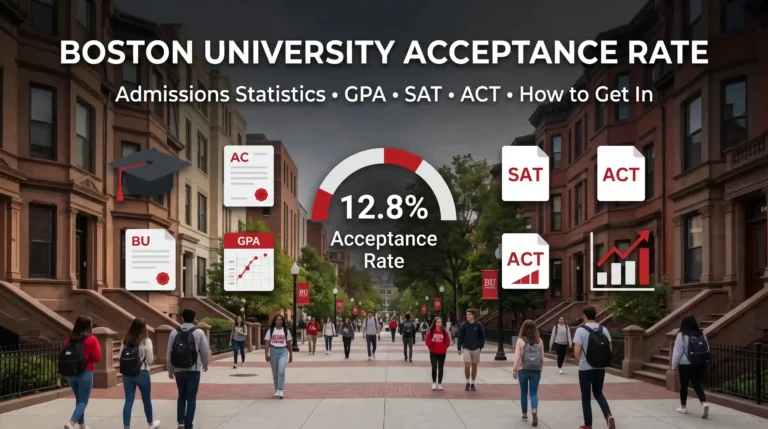
For the latest completed first-year admission cycle, Boston University admitted about 12.8% of applicants. BU received 76,776 applications for fall 2025 and enrolled about 3,450 first-year students.
That means roughly 13 out of every 100 applicants were admitted, making BU a highly selective university.
Boston University Acceptance Rate
Boston University’s latest official figures show:
| Admission Statistic | Fall 2025 |
|---|---|
| Total first-year applicants | 76,776 |
| Applicants admitted | 9,853 |
| Approx. acceptance rate | 12.8% |
| First-year students enrolled | 3,450 |
| Early Decision share of enrolled class | 59% |
| Average entering GPA | 3.86–3.87 |
| Average SAT among students who submitted scores | About 1,465–1,466 |
| Average ACT among students who submitted scores | 32 |
BU’s 2025–2026 Common Data Set reports 76,776 applicants and 9,853 admitted students, which produces an admission rate of approximately 12.83%. BU’s own Class of 2029 reporting also gives a 12.83% admit rate.
Is Boston University Hard to Get Into?
Yes. Boston University is highly selective.
A 12.8% acceptance rate means that most students who apply are not admitted. The university’s incoming class also has strong academic credentials. BU reports that 86% of enrolled first-year students ranked in the top 10% of their high school class, while the middle 50% GPA range was 3.7–4.0.
The competition can be especially strong for popular programs and colleges within BU, although the university’s overall acceptance rate should not be treated as the admission rate for every individual program.
Boston University Acceptance Rate Over Time
BU’s acceptance rate has declined substantially over the past several years.
| Class | Approx. Acceptance Rate |
|---|---|
| Class of 2025 | 18.3% |
| Class of 2026 | 14% |
| Class of 2029 | 12.83% |
For the Class of 2025, BU admitted 18.3% of applicants. The Class of 2026 had an acceptance rate of about 14%, and the Class of 2029 had a 12.83% admit rate.
The numbers show why applicants should not rely on older BU acceptance-rate figures when estimating their chances today.
Why Is BU So Competitive?
Several factors contribute to Boston University’s selectivity.
A Large Applicant Pool
BU received 76,776 first-year applications for fall 2025.
When a university receives tens of thousands of applications but has a limited number of spaces, the overall acceptance rate naturally becomes more competitive.
Strong Academic Applicants
The Class of 2029 had an average entering GPA of about 3.86–3.87, while the average SAT among students who submitted scores was approximately 1,465–1,466 and the average ACT was 32.
Early Decision
Early Decision plays a significant role in BU’s incoming class. 59% of the Class of 2029 enrolled through Early Decision, according to BU.
That does not mean an applicant should choose Early Decision simply to improve admission chances. It is a binding commitment, so students should apply Early Decision only when BU is genuinely their first choice and they understand the financial and enrollment implications.
Boston University GPA Requirements
BU does not publish a simple minimum GPA that guarantees or automatically qualifies an applicant for admission.
Instead, admissions decisions are holistic.
For the Class of 2029, BU reports a 3.7–4.0 middle 50% GPA range, with an average entering GPA of about 3.86.
That means a strong academic record matters considerably.
Students should focus not only on the final GPA but also on:
- Course rigor
- Grades in challenging classes
- Academic improvement
- Performance in subjects related to the intended field of study
A student with a GPA outside the typical range is not automatically rejected, just as a student with a high GPA is not automatically admitted.
Does Boston University Require the SAT or ACT?
No. Boston University is currently test optional for first-year applicants.
BU says its test-optional policy applies to first-year applicants applying through fall 2028 and spring 2029, and it applies across BU’s undergraduate schools and colleges as well as scholarship programs.
Students can choose whether they want BU to consider SAT or ACT scores.
That creates an important question:
Should You Submit Your SAT or ACT Score?
There is no universal answer.
A strong score that reflects your academic ability may strengthen an application. Students whose scores do not represent their academic strengths can choose not to submit them.
Among students who enrolled in the Class of 2029 and submitted scores, the average SAT was about 1,465–1,466, while the average ACT was 32.
These are averages among students who submitted scores, not minimum admission requirements.
Does Boston University Superscore the SAT and ACT?
Yes.
BU says it superscores both the SAT and ACT. For the SAT, BU considers the highest score from each section, regardless of test date. For the ACT, BU recalculates a composite based on the highest section scores.
That can benefit students who have taken an exam more than once and improved individual sections over time.
Boston University Admissions Requirements
Applicants should carefully review BU’s current requirements because requirements can vary by program.
For a typical first-year application, students should expect to submit application materials through the required application system and provide academic records and recommendations.
BU lists requirements that include:
- Application
- High school transcript
- School Counselor Recommendation
- School Report Form
- Teacher Evaluation
- Additional materials where required by a particular program
SAT and ACT scores are optional under BU’s current test policy.
Students applying to programs such as the College of Fine Arts may also have portfolio, audition, or other program-specific requirements.
Boston University International Student Requirements
International applicants have additional requirements.
BU says international students must provide evidence of English-language proficiency through an accepted examination such as:
- TOEFL
- IELTS
- Duolingo English Test
BU states that these tests remain required for international students as the primary means of evaluating English-language proficiency.
International applicants should also carefully review financial documentation and other requirements that apply to their situation.
What Does Boston University Look For?
A strong application is about more than one number.
BU describes its admissions process as considering the overall applicant rather than relying on a single factor. Its current test-optional policy specifically tells students to consider their academic record, contributions inside and outside the classroom, and their communities when deciding whether to submit test scores.
Strong applicants generally present a combination of:
Strong academics:
Good grades in challenging courses provide evidence that you can handle university-level work.
Meaningful activities:
Quality matters more than simply collecting extracurricular activities. Long-term involvement, leadership, work, service, athletics, research, arts, or other meaningful commitments can help tell your story.
A clear personal narrative:
Your essays should show who you are, what matters to you, and why BU makes sense for your goals.
Strong recommendations:
Teachers and counselors can provide context about your academic ability, character, and contribution to the school community.
Boston University Early Decision
BU offers Early Decision for first-year applicants.
The Class of 2029 provides an important illustration of how significant Early Decision is at BU: 59% of enrolled first-year students came through Early Decision.
Early Decision is binding. Students admitted under a binding Early Decision agreement are expected to enroll and withdraw applications from other colleges.
Because of that commitment, students should think carefully before choosing Early Decision.
It may make sense for someone who:
- Has a clear first-choice university
- Has researched the academic programs carefully
- Is comfortable with the binding nature of the decision
- Has considered the financial implications
Boston University Class of 2029 Profile
The Class of 2029 gives applicants a useful picture of the students who actually enrolled.
BU reports:
| Class of 2029 Statistic | Figure |
|---|---|
| Applicants | 76,776 |
| Admit rate | 12.8% |
| Enrolled | 3,450 |
| Middle 50% GPA | 3.7–4.0 |
| Average SAT* | 1,465 |
| Average ACT* | 32 |
| Top 10% of high school class | 86% |
| First-generation students | 20% |
| International students | 20.7% |
*Average among students who submitted scores. BU’s test-optional policy means not every enrolled student submitted an SAT or ACT score.
What Are Your Chances of Getting Into Boston University?
No website, calculator, or acceptance-rate statistic can accurately predict an individual student’s admission decision.
A student with excellent grades and test scores can still be denied, while another student with a less traditional academic profile may be admitted.
Instead of asking only:
“Is my GPA high enough?”
consider your entire application:
Academic strength + course rigor + activities + essays + recommendations + fit + overall context
BU’s own class profile demonstrates that the university enrolls students from a wide range of backgrounds and experiences.
How to Improve Your Chances at Boston University
Take Challenging Classes
If your high school offers honors, AP, IB, dual-enrollment, or other advanced courses, choose challenging classes that make sense for your academic preparation.
The goal is not to overload yourself simply to make your transcript look impressive. Strong performance in rigorous coursework is more valuable than taking classes that are unnecessarily difficult and hurting your grades.
Build Depth in Extracurricular Activities
You do not need dozens of activities.
A smaller number of meaningful commitments can demonstrate leadership, initiative, responsibility, or genuine interests.
For example, sustained involvement in a club, community organization, job, research project, sport, artistic activity, or family responsibility can provide useful context.
Write Specific Essays
Avoid writing an essay that could be sent to any university.
Explain what motivates you, what you have learned, and how your experiences have shaped your goals.
Choose Your Test Strategy Carefully
Since BU is test optional, submit scores when you believe they strengthen your application.
Do not submit a score simply because you think every applicant must submit one. BU explicitly gives applicants the choice.
Apply Early Only When It Makes Sense
Early Decision can be attractive because a large portion of BU’s enrolled class comes through it, but it is binding.
Make the choice based on genuine fit rather than treating Early Decision as a guaranteed shortcut.
Is a 3.5 GPA Good Enough for Boston University?
A 3.5 GPA does not automatically disqualify you, but it would generally fall below the middle 50% GPA range reported for BU’s Class of 2029.
That means a student with a 3.5 GPA may need other parts of the application to provide additional context and demonstrate academic readiness.
Course rigor also matters. A 3.5 GPA earned in an especially demanding schedule can tell a different story from a 3.5 GPA earned in less challenging coursework.
Is a 4.0 GPA Enough to Get Into BU?
A 4.0 GPA is an excellent academic credential, but it does not guarantee admission.
BU is selective enough that admission decisions depend on more than GPA.
A 4.0 applicant may still be competing against thousands of other academically strong students.
The Class of 2029 profile shows just how competitive the applicant pool is, with 76,776 applications and only a 12.8% overall admit rate.
Boston University Acceptance Rate vs. Other Universities
Acceptance rates can be useful for understanding selectivity, but they should not be the only factor used when comparing universities.
A lower acceptance rate does not necessarily mean a school offers a better education.
Students should also compare:
- Academic programs
- Faculty
- Location
- Internship opportunities
- Research
- Campus culture
- Financial aid
- Graduation outcomes
- Career opportunities
- Overall cost
For applicants considering BU, the acceptance rate mainly tells you one thing: admission is competitive.
Frequently Asked Questions
What is Boston University’s acceptance rate?
Boston University’s latest completed first-year admission rate is approximately 12.8%. BU reported 76,776 applicants and an admit rate of 12.83% for the Class of 2029.
How many students applied to Boston University?
BU received 76,776 first-year applications for fall 2025.
How many students did BU admit?
Boston University’s 2025–2026 Common Data Set reports 9,853 admitted first-year students.
What GPA do you need for Boston University?
BU does not publish a universal minimum GPA for admission. The Class of 2029 had a 3.7–4.0 middle 50% GPA range, with an average entering GPA of about 3.86–3.87.
Is Boston University test optional?
Yes. BU is test optional for first-year applicants applying through fall 2028 and spring 2029.
What SAT score should I have for BU?
There is no required SAT score under BU’s current test-optional policy. Among enrolled Class of 2029 students who submitted test scores, the average SAT was about 1,465–1,466.
What ACT score should I have?
The Class of 2029 had an average ACT score of 32 among students who submitted scores. It is not a minimum requirement.
Does Boston University offer Early Decision?
Yes. Early Decision is an important part of BU’s undergraduate admissions process, and 59% of the Class of 2029 enrolled through Early Decision.
Is Boston University an Ivy League school?
No. Boston University is not an Ivy League university. It is a private research university and a member of the Boston academic community.
Final Thoughts
Boston University is a highly selective university with an acceptance rate of about 12.8% based on the latest completed first-year admission cycle.
The numbers are competitive: tens of thousands of students apply, while the enrolled first-year class is only a few thousand students.
Successful applicants should focus on building a strong overall application rather than chasing one magic GPA or test score. Strong coursework, meaningful activities, compelling writing, recommendations, and a clear sense of academic and personal direction can all contribute to a competitive application.
And because BU remains test optional through fall 2028 and spring 2029, students should make an informed decision about whether submitting SAT or ACT scores strengthens their application.
For the most accurate information, always check Boston University’s official admissions pages and the latest Common Data Set before applying, because admission policies, deadlines, and statistics can change.