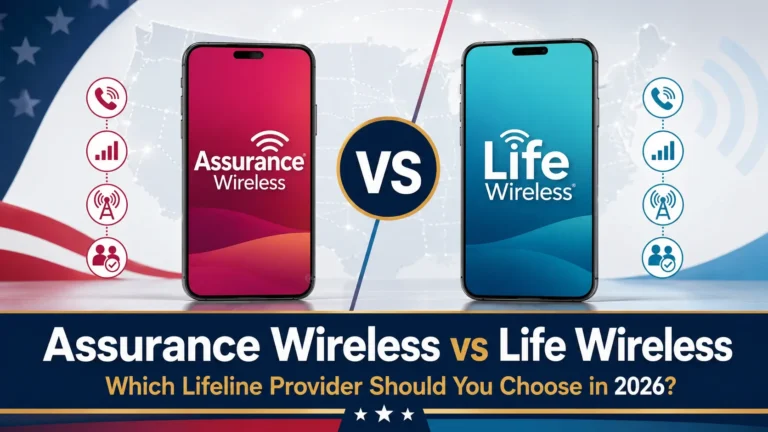
Assurance Wireless and Life Wireless both offer Lifeline-supported phone service to eligible households. Each provider includes unlimited talk and text on qualifying plans, but their data rules, networks, phone options, and service areas are not the same.
Assurance Wireless is often the stronger choice when T-Mobile coverage works well at your address and you want a clearly published 10GB plan. Life Wireless may suit you better when its coverage is stronger locally or you want limited data access to continue at a slower speed after your high-speed allowance runs out.
Neither provider wins in every ZIP code. Check the actual plan, phone offer, and coverage available at your home before you transfer your Lifeline benefit.
Quick verdict: Assurance Wireless has the clearer overall plan and names the T-Mobile network. Life Wireless offers broad state availability and keeps data working at up to 256 kbps after the high-speed allowance, but its high-speed data amount varies by state. Phone models are never guaranteed by either company.
Assurance Wireless vs Life Wireless at a glance
| Feature | Assurance Wireless | Life Wireless |
|---|---|---|
| Lifeline service | Yes | Yes |
| Standard monthly price | $0 for the published Lifeline plan | $0 for qualifying state Lifeline plans |
| Talk and text | Unlimited | Unlimited |
| Published high-speed data | 10GB on the standard plan; 12GB for California and qualifying Tribal plans | Varies by state; some published state plans show 4.5GB or 6GB |
| Data after high-speed allowance | Standard-plan data access ends after 10GB | Reduced to up to 256 kbps until renewal |
| Paid data option | 15GB for $10 per year or $1 per month; eligibility and access limits apply | Recharge options are available; prices and availability vary |
| Network | T-Mobile 4G LTE and 5G where available | Nationwide 5G/4G network; underlying carrier is not named on the main public plan page |
| Free phone | Limited-time or qualifying offers may include a basic smartphone | A smartphone may be provided under a qualifying offer |
| BYOD | Yes, after an IMEI compatibility check | Yes, with a compatible phone |
| Keep your number | Number transfer is supported | Number transfer is supported |
| Credit check or contract | No annual contract or credit check for Lifeline service | No contract or credit check advertised |
| Best for | Clearer data plan and strong T-Mobile coverage | Customers whose local Life Wireless offer and coverage are better |
Plan details can change by state, eligibility category, and promotion. Enter your ZIP code on both providers’ official websites before making a decision.
What is Assurance Wireless?
Assurance Wireless is a Lifeline provider that supplies wireless service over the T-Mobile network. Its current standard Lifeline plan lists unlimited talk, unlimited text, and 10GB of high-speed data for $0 per month.
Customers can bring a compatible phone or purchase a low-cost device. Assurance also promotes limited-time free-phone offers, but the available model depends on eligibility, state, inventory, and the offer shown during enrollment.
Assurance’s public plan page is unusually clear about what happens after the standard data allowance: data access ends after you use the included 10GB. Customers who need more can ask about a low-cost 15GB plan priced at $10 per year or $1 per month, plus applicable tax.
What is Life Wireless?
Life Wireless is a Lifeline service operated by Telrite Corporation. Its qualifying plans include unlimited talk, unlimited text, and high-speed data at no monthly service cost, with the data allowance changing by state.
The company publishes a long list of participating states and territories on its plan page. Examples reviewed for this comparison included 4.5GB plans in New York and Michigan and a 6GB plan in Kentucky. Your state may have a different amount.
Life Wireless says data speed drops to 256 kbps after the high-speed allowance is used. Slow data may still support messaging, email, or light web use, but it will not feel like normal 4G or 5G service.
Plans and high-speed data compared
Data is one of the clearest differences between Assurance Wireless and Life Wireless.
Assurance Wireless plan
The standard Assurance Lifeline plan currently includes:
- $0 monthly price
- Unlimited talk
- Unlimited text
- 10GB of high-speed data
- No upfront activation charge
- BYOD or access to low-cost phone options
The standard plan stops mobile data access after the 10GB allowance is used. Unused service generally does not create an extra data balance for the next month.
California and qualifying Tribal plans list 12GB of high-speed data. Assurance also publishes a Data Peace of Mind option with 15GB for $10 per year or $1 per month. Its qualifying Tribal version lists 18GB. Access to the low-cost upgrade is restricted, so confirm that the option is available to your account.
Life Wireless plan
Life Wireless includes the following core features on its state Lifeline plans:
- $0 qualifying monthly service
- Unlimited nationwide calls
- Unlimited texts
- A state-specific high-speed data allowance
- Free activation
- BYOD support
- Calling features such as voicemail, call waiting, and three-way calling
The provider does not show one nationwide high-speed data amount. Its state pages must be checked individually. Once the high-speed allowance is used, data is reduced to 256 kbps until the next monthly renewal.
Which provider offers more data?
Assurance Wireless wins when you compare its published 10GB standard plan with a Life Wireless state plan offering 4.5GB or 6GB. A different Life Wireless allowance may apply where you live, so a national answer can be misleading.
Life Wireless has one practical advantage after the allowance is gone. Its terms say data continues at a reduced speed, while Assurance states that access ends after the standard plan reaches 10GB.
Choose based on how you use your phone:
- Pick Assurance if you need a larger published high-speed allowance and rarely exceed 10GB.
- Consider Life Wireless if your local plan is competitive and having very slow backup data is better than losing data access entirely.
- Use Wi-Fi when possible if you stream video, attend video calls, or download large files because either allowance can disappear quickly.
Free phone and device options
The phrase “free government phone” often creates the wrong expectation. Lifeline is a service discount, not a promise that every approved customer can choose any smartphone for free.
Assurance Wireless phone options
Assurance may provide a free basic smartphone during a qualifying limited-time offer. Its standard plan page also tells customers they can bring a phone or buy a low-cost device, and its public phone store lists models that may vary by state.
You should not expect a specific Samsung, Motorola, or iPhone model. Check the final enrollment screen before assuming that a device is included.
Life Wireless phone options
Life Wireless states that it may provide a device at no charge, sell a device, or let you use your own compatible phone. The activation page refers to a free smartphone or BYOD, but inventory and eligibility can affect what is offered.
Model, storage, camera quality, 5G support, and device condition should be confirmed before you accept the offer. A social media advertisement is not proof that the same phone will be available in your state.
Which provider has better phones?
There is no reliable nationwide winner because both companies change phone inventory. Assurance publishes a low-cost phone store and a clear BYOD checker, which makes its device process easier to inspect before enrollment.
Life Wireless can still be the better choice if its local representative or online application gives you a suitable phone. Compare the device shown in your real offer, not a model featured in an old article or video.
Bring your own phone
Both providers support BYOD, which can be the safest option when you already own a good unlocked phone.
Assurance Wireless provides an IMEI checker and says most compatible phones need a SIM card or eSIM. T-Mobile network compatibility matters, and some older devices may not support the bands or voice technology required for activation.
Life Wireless also lets customers bring a compatible device. Its terms require the phone to work with the technology used by its underlying carrier and prohibit devices designed only for data service.
Before transferring service:
- Confirm that your phone is carrier-unlocked.
- Check the IMEI with the new provider.
- Back up contacts, photos, texts, and voicemail.
- Ask whether you need a physical SIM or eSIM.
- Do not cancel your old service before a number transfer is complete.
Assurance warns that number transfers can briefly create service on both networks. Wait for the provider’s confirmation before removing the old SIM or closing the previous account.
Network and coverage comparison
Coverage matters more than a free phone. A generous data allowance provides little value when calls drop inside your home or mobile data fails where you work.
Assurance Wireless coverage
Assurance clearly states that its service runs on the T-Mobile network, including 4G LTE and 5G where available. Customers who already receive strong T-Mobile or Metro coverage may have a good starting point, but network priority and indoor reception can differ.
Assurance customers may experience slower speeds during congestion. The company also notes that T-Mobile-branded plans may receive higher data priority than Assurance-branded plans.
Life Wireless coverage
Life Wireless advertises nationwide 5G coverage and provides a coverage map. Its main consumer pages refer to an underlying carrier without publicly naming that carrier, so you should not assume it uses the same network in every market.
Coverage maps estimate outdoor service and cannot guarantee indoor reception. Hills, building materials, local tower load, weather, and phone compatibility can affect your experience.
Coverage winner
Assurance has an information advantage because it names T-Mobile. Life Wireless may still offer better service at your address.
Check both maps and ask nearby users about real reception. If possible, test service before moving an important phone number.
Lifeline eligibility for both providers
Assurance Wireless and Life Wireless follow the federal Lifeline eligibility rules. Neither company can approve someone who fails the required eligibility check.
You may qualify through household income or participation in an accepted program.
Qualifying assistance programs
Common federal pathways include:
- Supplemental Nutrition Assistance Program (SNAP)
- Medicaid
- Supplemental Security Income (SSI)
- Federal Public Housing Assistance (FPHA)
- Veterans Pension or Survivors Benefit
- Bureau of Indian Affairs General Assistance on qualifying Tribal lands
- Tribal Temporary Assistance for Needy Families
- Food Distribution Program on Indian Reservations
- Head Start for households meeting the Tribal income standard
2026 Lifeline income limits
Your household income may qualify when it is at or below 135% of the 2026 Federal Poverty Guidelines.
| Household size | 48 states, D.C. and territories | Alaska | Hawaii |
| 1 | $21,546 | $26,933 | $24,786 |
| 2 | $29,214 | $36,518 | $33,602 |
| 3 | $36,882 | $46,103 | $42,417 |
| 4 | $44,550 | $55,688 | $51,233 |
| 5 | $52,218 | $65,273 | $60,048 |
| 6 | $59,886 | $74,858 | $68,864 |
| 7 | $67,554 | $84,443 | $77,679 |
| 8 | $75,222 | $94,028 | $86,495 |
| Each extra person | Add $7,668 | Add $9,585 | Add $8,816 |
State-specific Lifeline programs may have extra rules or qualifying pathways. California, Oregon, and Texas can use different application processes or state administration.
Documents you may need
The National Verifier may confirm eligibility automatically. If it cannot, you may be asked for readable documents showing identity, address, income, or program participation.
Common examples include:
| Proof needed | Possible document |
| Identity | Driver’s license, state ID, passport, or accepted government record |
| Program participation | SNAP, Medicaid, SSI, housing, or pension benefit letter |
| Income | Tax return, current income statement, benefit statement, or recent pay stubs |
| Address | Lease, utility bill, tax document, or another accepted record |
| Separate household | Lifeline household worksheet when another subscriber lives at the same address |
Do not send your EBT PIN, online banking password, or full debit-card information. Lifeline verification does not require access to your benefit balance.
How to apply
Applying for Assurance Wireless
- Enter your ZIP code on the Assurance availability page.
- Start the online application, call customer care, or apply with an authorized local representative.
- Provide your identity, address, and eligibility details.
- Upload documents if automatic verification fails.
- Review the plan and phone offer before accepting.
- Activate the supplied SIM, eSIM, or phone after approval.
Assurance says customers can also call 1-888-321-5880 for application help.
Applying for Life Wireless
- Select your state and check the plan shown by Life Wireless.
- Enter your ZIP code and email to begin enrollment.
- Complete the National Verifier or applicable state eligibility process.
- Submit requested documents through the approved portal.
- Choose an available phone or BYOD option.
- Activate service and register your account after approval.
Life Wireless provides an online application and status tool. Customer service is available at 1-888-543-3620 or by dialing 611 from a Life Wireless phone.
Customer service and account tools
Assurance Wireless lists customer care at 1-888-321-5880, seven days a week from 7 a.m. to 7 p.m. Central Time. Its website includes account login, application-status, activation, data-management, and phone-setup resources.
Life Wireless offers support at 1-888-543-3620, by dialing 611, through email, or through its contact form. Its terms list normal customer-service hours as Monday through Saturday from 9 a.m. to 6 p.m. Eastern Time.
Support quality can change by issue and wait time. Save your application ID, shipping details, submitted documents, and any chat or email confirmations until your service is working.
Pros and cons
| Provider | Pros | Cons |
| Assurance Wireless | Clear 10GB standard plan; T-Mobile network; eSIM and physical SIM support; IMEI checker; seven-day customer service; 15GB low-cost option | Standard data stops after 10GB; coverage and phone offers vary; network priority may be lower during congestion |
| Life Wireless | Unlimited talk and text; state-specific plans; data continues at 256 kbps after high-speed use; free activation; BYOD and number transfer | High-speed allowance varies; underlying network is not clearly named on main plan pages; phone model is not guaranteed |
Who should choose Assurance Wireless?
Assurance may be the better provider when:
- T-Mobile coverage is strong at your home, work, and school.
- You want a published 10GB high-speed data allowance.
- You prefer an online IMEI checker before applying.
- You want eSIM as a possible activation option.
- You value customer service seven days a week.
- You can use Wi-Fi after the standard data allowance ends.
Who should choose Life Wireless?
Life Wireless may be the better choice when:
- Its coverage map and local feedback are stronger in your area.
- Its state plan offers enough high-speed data for your needs.
- You want slow data to continue after the high-speed allowance is used.
- You already have a compatible unlocked phone.
- Life Wireless is available where Assurance is not.
- Its enrollment or local support process is easier for you.
Can you have Assurance Wireless and Life Wireless together?
No household can receive two Lifeline discounts at the same time. USAC allows only one benefit per household, whether it is used for phone, internet, or a bundled service.
Separate economic households living at the same address may sometimes qualify independently. Each group must have separate income and expenses and may need to complete the Lifeline household worksheet.
Can you switch between the providers?
You can usually transfer your Lifeline benefit from one company to another. The new provider will request your consent and the transfer ends the benefit with the old company.
Check coverage, phone compatibility, data, and number-porting instructions before switching. Do not cancel your old line early when keeping your current phone number is important.
Lifeline usage and annual eligibility rules continue after a transfer. Use your service at least once every 30 days and respond to recertification requests to avoid losing the benefit.
What happened to the Affordable Connectivity Program?
The Affordable Connectivity Program ended on June 1, 2024 after federal funding ran out. Old pages may combine ACP offers with Lifeline and show data or device benefits that no longer apply.
Assurance Wireless and Life Wireless continue to participate in Lifeline. Compare their current Lifeline pages rather than relying on an expired ACP advertisement.
Frequently asked questions
Is Assurance Wireless better than Life Wireless?
Assurance has the stronger published standard plan for many customers because it lists 10GB of high-speed data and clearly uses T-Mobile. Life Wireless can be better when its coverage or state-specific offer works better at your address.
Which provider gives more high-speed data?
Assurance currently lists 10GB on its standard $0 plan. Life Wireless changes the amount by state, with some reviewed pages listing 4.5GB or 6GB. Check your state before comparing.
Does Assurance Wireless provide a free phone?
A limited-time offer may include a free basic smartphone for an eligible applicant. The provider also offers BYOD and low-cost phone options. No model is guaranteed.
Does Life Wireless provide a free smartphone?
Life Wireless may provide a phone free of charge, offer one for purchase, or let you bring your own. Availability depends on your state, eligibility, promotion, and inventory.
What network does Assurance Wireless use?
Assurance Wireless uses the T-Mobile 4G LTE and 5G network where available.
What network does Life Wireless use?
Life Wireless advertises nationwide 5G and 4G coverage but does not identify its underlying carrier on the main public plan page. Use its coverage map for your address instead of assuming a particular host network.
Can SNAP or Medicaid qualify me?
Yes. SNAP and Medicaid are federal Lifeline qualifying programs. Approval still requires identity, address, duplicate-benefit, and eligibility verification.
Can I receive both providers’ free service?
No. Only one Lifeline discount is allowed per household. You may switch providers, but you cannot keep both benefits active.
Do the plans require a contract or credit check?
Both providers advertise Lifeline service without a credit check or annual contract. Review any device purchase, recharge, tax, and replacement terms separately.
Final verdict
Assurance Wireless is the better overall starting point for customers who have strong T-Mobile coverage. Its standard $0 plan includes unlimited talk, unlimited text, and 10GB of high-speed data, while its BYOD checker and published plan labels make comparison easier.
Life Wireless remains a good option when local coverage is stronger or its state plan meets your needs. Reduced data at 256 kbps after the high-speed allowance can be useful for basic messaging and light internet access.
Do not choose either provider based only on an advertised free phone. Compare the offer tied to your ZIP code, check coverage where you spend time, verify the exact data rules, and confirm phone availability before transferring your Lifeline benefit.