
New York University (NYU) has become significantly more selective as applications have increased. For students researching the NYU acceptance rate, however, one number does not tell the whole story. NYU has multiple undergraduate schools and global campuses, while programs such as Stern, Tisch, nursing, medicine, and graduate schools have their own admissions processes.
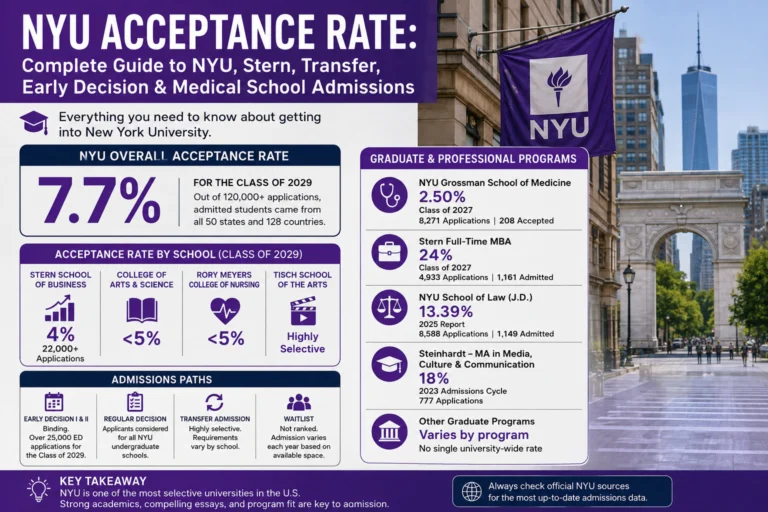
For the Class of 2029, NYU reported an overall undergraduate admission rate of 7.7%, after receiving more than 120,000 applications. Three undergraduate colleges—College of Arts & Science, Stern School of Business, and Rory Meyers College of Nursing—had admission rates below 5%.
The Class of 2030 is now entering NYU in fall 2026, but a final university-wide acceptance rate for that class should not be confused with estimates published by third parties. This guide separates confirmed figures from estimates and explains what applicants should know.
What Is the NYU Acceptance Rate?
The most recently reported university-wide acceptance rate for NYU’s Class of 2029 was 7.7%.
NYU received more than 120,000 applications for that entering class. The university’s selectivity has changed dramatically over the past decade as application volume has grown.
| NYU Class | Approx. Applications | Acceptance Rate |
|---|---|---|
| Class of 2029 | 120,000+ | 7.7% |
| Class of 2028 | 118,000 | About 8% |
| Class of 2027 | 120,000+ | About 8% |
| Class of 2026 | About 100,000+ | About 12% |
| Class of 2025 | About 100,000 | About 13% |
Historical figures vary somewhat depending on whether the source is reporting NYU’s global undergraduate network or a particular campus/data set. For that reason, applicants should always check what population a reported acceptance rate represents.
NYU Acceptance Rate 2026
The phrase “NYU acceptance rate 2026” can be confusing because it may refer to different admission cycles.
Students entering NYU in fall 2026 are generally part of the Class of 2030. NYU’s admissions materials confirm that Class of 2030 applicants were admitted through the current admissions process, and NYU schools are already welcoming Class of 2030 students.
As of August 2026, applicants should be careful about websites that present a projected Class of 2030 acceptance rate as an official NYU figure. A projection is not the same as a published university statistic.
Bottom line: the latest clearly reported overall rate is 7.7% for the Class of 2029. Use that figure as the latest established benchmark rather than treating an unofficial Class of 2030 projection as fact.
NYU Acceptance Rate 2025
The NYU acceptance rate for the Class of 2029, announced in 2025, was approximately 7.7%.
More than 120,000 students applied, making the admission cycle one of the most selective in NYU’s history. NYU also reported a record Early Decision applicant pool of more than 25,000 applicants during that cycle.
The increased applicant volume is one reason the overall admission percentage has fallen considerably compared with previous years.
NYU Acceptance Rate 2024
The acceptance rate associated with the previous admission cycle was higher than the 7.7% reported for the Class of 2029.
Depending on the data set and whether the calculation includes NYU’s global network, published figures for the Class of 2028 are generally around 8%. NYU’s admissions selectivity therefore continued to tighten from the previous cycle.
When researching NYU acceptance rate 2024, it is important to identify the class year rather than relying only on the calendar year.
NYU University Acceptance Rate
The NYU university acceptance rate refers to the overall admission rate rather than the rate for an individual school.
That distinction matters because NYU contains several undergraduate colleges and schools with different applicant pools.
For example, NYU’s Class of 2029 had an overall rate of 7.7%, while Stern, CAS, and Rory Meyers Nursing were each reported at below 5%.
Therefore, an applicant interested in business should not assume that the general NYU acceptance rate represents their chances of getting into Stern.
NYU Stern Acceptance Rate
The NYU Stern acceptance rate is considerably lower than NYU’s overall rate.
For the Class of 2029, NYU Stern reported approximately:
- 22,000 applications
- Approximately 4% admission rate
- Projected median SAT around 1550
These figures come from NYU Stern’s own 2025 faculty orientation materials.
That makes undergraduate Stern admission substantially more competitive than admission to NYU as a whole.
NYU Stern Undergraduate Acceptance Rate
The NYU Stern undergraduate acceptance rate is approximately 4% for the Class of 2029 based on Stern’s reported figures.
This is an important distinction from the Stern MBA acceptance rate, which is much higher.
NYU Stern Acceptance Rate Undergraduate vs. MBA
NYU Stern has separate undergraduate and graduate business admissions.
Stern Undergraduate
For the Class of 2029:
Approximately 4%
Stern Full-Time MBA
For the Class of 2027, Stern reports:
- 4,933 applications
- 1,161 admits
- 24% admission rate
- 336 enrolled students
This illustrates why searches for NYU Stern acceptance rate can produce very different numbers. A 4% undergraduate figure should not be compared directly with the 24% MBA admission rate.
NYU Stern MBA Acceptance Rate
The latest official Stern Full-time MBA class profile reports an admission rate of 24% for the Class of 2027.
Stern received 4,933 applications and admitted 1,161 candidates.
Therefore, if you’re searching for the NYU Stern MBA acceptance rate, the appropriate figure is approximately 24% for the Class of 2027, rather than the approximately 4% undergraduate rate.
NYU Stern Transfer Acceptance Rate
NYU Stern does not publish a simple annual percentage that can reliably be called its transfer acceptance rate.
What Stern does state is that undergraduate transfer admission is highly selective. Applicants must complete specific coursework before transferring, and Stern considers students applying for fall admission.
Because the school does not provide a current official transfer acceptance percentage on its transfer admissions page, applicants should be skeptical of websites presenting a precise number without explaining its source.
NYU Transfer Acceptance Rate
The NYU transfer acceptance rate is another statistic that can be difficult to interpret.
Transfer admission is different from first-year admission, and acceptance rates can vary significantly by school, semester, applicant pool, and available space.
NYU’s official transfer guidance explains who qualifies as a transfer applicant and outlines the application requirements, but it does not provide one universal transfer acceptance percentage for every NYU school.
Consequently, there is no single official number that accurately describes every NYU transfer applicant.
NYU Transfer Student Acceptance Rate
Students searching for the NYU transfer student acceptance rate should look beyond a single percentage.
NYU transfer applicants are evaluated according to their academic record, coursework, and the requirements of the specific school or program.
Stern, for example, describes its transfer process as highly selective.
A transfer applicant should therefore research the exact NYU school they want rather than using the 7.7% first-year acceptance rate as a transfer benchmark.
NYU Early Decision Acceptance Rate
NYU offers:
- Early Decision I
- Early Decision II
- Regular Decision
Early Decision is binding, meaning students admitted under an Early Decision agreement are expected to enroll at NYU, subject to the applicable terms.
NYU’s Class of 2029 had more than 25,000 Early Decision applications, a record applicant pool at the time.
However, NYU does not provide a single official Early Decision acceptance percentage that applicants can use as a guaranteed current rate.
Therefore, claims such as “NYU ED acceptance rate is exactly X%” should be treated cautiously unless the source provides a clearly documented NYU admissions data set.
NYU ED1 Acceptance Rate
ED1 refers to Early Decision I.
The application deadline for NYU’s Early Decision I round is generally earlier than Regular Decision, and applicants who are admitted through a binding Early Decision agreement are expected to enroll.
NYU has not established a publicly reported universal ED1 acceptance percentage that can be applied to every NYU undergraduate school.
Because NYU’s schools have different levels of selectivity, the practical admission rate may vary considerably by program.
NYU ED2 Acceptance Rate
ED2, or Early Decision II, is another binding application round.
Like ED1, the university does not provide a single official percentage that represents the ED2 acceptance rate for every undergraduate school.
Applicants should also remember that NYU’s Early Decision rounds are not necessarily equivalent across Stern, Tisch, CAS, Nursing, and other programs.
NYU RD Acceptance Rate
RD means Regular Decision.
NYU’s overall Class of 2029 acceptance rate was 7.7%, but this is an overall figure and should not be interpreted as a Regular Decision-only acceptance rate.
NYU’s published overall rate combines the broader admission process rather than giving applicants a simple “RD percentage” that applies to every school.
NYU Acceptance Rate for Early Decision vs. Regular Decision
It is tempting to assume that Early Decision automatically provides a major admissions advantage.
That is not a safe conclusion.
NYU’s Early Decision applicant pool is extremely large, and the university evaluates applicants within the context of the school and program to which they apply.
For the Class of 2029, more than 25,000 students applied Early Decision.
Students should apply Early Decision because NYU is genuinely their preferred institution—not simply because they expect a particular acceptance-rate advantage.
NYU College of Arts and Science Acceptance Rate
The NYU College of Arts & Science (CAS) is among NYU’s most selective undergraduate schools.
For the Class of 2029, NYU reported that CAS had an admission rate of less than 5%.
NYU does not need to have one identical rate every year, so applicants should avoid treating “under 5%” as a permanent CAS acceptance rate.
CAS NYU Acceptance Rate
Searches for CAS NYU acceptance rate refer to the College of Arts & Science.
The latest publicly reported figure for the Class of 2029 places CAS below 5%.
That makes CAS substantially more selective than the overall NYU rate of 7.7%.
NYU Gallatin Acceptance Rate
The Gallatin School of Individualized Study has a distinctive admissions process because students create individualized academic programs.
NYU does not publish a current official standalone acceptance rate for Gallatin that should be presented as a definitive percentage.
Students interested in Gallatin should focus on demonstrating intellectual curiosity, academic preparation, and a convincing reason why its individualized curriculum fits their goals.
NYU Gallatin and Liberal Arts Acceptance Rate
Searches for NYU Gallatin and liberal arts acceptance rate can combine two different NYU options.
Gallatin is its own individualized-study school, while Liberal Studies is a separate NYU academic pathway.
NYU’s Liberal Studies admissions information confirms that only a select group of first-year applicants receive admission.
Because NYU does not provide a simple current percentage for both programs combined, applicants should not rely on an unofficial “Gallatin and Liberal Arts acceptance rate.”
NYU Liberal Studies Acceptance Rate
NYU’s Liberal Studies admissions process is selective, but NYU does not publish a universal current acceptance percentage on its admissions page.
The program can also include opportunities to begin studies at NYU’s global academic centers before continuing through the NYU curriculum.
NYU Tisch Acceptance Rate
The Tisch School of the Arts is highly selective, but its admission process is different from many traditional academic programs because certain Tisch programs require creative portfolios, auditions, or other specialized materials.
For that reason, applicants should not assume that the general NYU acceptance rate represents Tisch admission.
NYU also has specialized Tisch programs with their own application processes. For example, the Clive Davis Institute reports approximately 500 applications per year and 60 admissions, which corresponds to roughly 12% for that particular program—not Tisch as a whole.
This is a good example of why program-specific numbers should not be generalized to an entire school.
Acceptance Rate Tisch NYU
The phrase acceptance rate Tisch NYU generally refers to undergraduate admission to the Tisch School of the Arts.
However, Tisch contains multiple programs, and admissions requirements differ by program.
Applicants should therefore look at the exact Tisch major or program rather than relying on a single school-wide percentage.
NYU Film School Acceptance Rate
NYU’s film-related undergraduate programs are part of Tisch.
There is no single reliable acceptance rate for every “NYU film school” applicant because different Tisch programs can have different application requirements and selection processes.
Portfolio quality, creative work, academic preparation, and the specific program can all matter.
NYU Steinhardt Acceptance Rate
NYU Steinhardt includes programs in education, music, media, health, applied psychology, and other fields.
A single school-wide acceptance rate can therefore be misleading.
For graduate programs, acceptance rates may be published at the program level. For example, NYU Steinhardt’s MA in Media, Culture, and Communication reported an 18% acceptance rate in its 2023 admissions cycle, based on 777 applications.
That figure should not be interpreted as the acceptance rate for every Steinhardt undergraduate or graduate program.
NYU Meyers Acceptance Rate
The Rory Meyers College of Nursing is one of NYU’s most selective undergraduate schools.
For the Class of 2029, NYU reported that the school admitted less than 5% of applicants.
Students applying to Meyers Nursing should therefore expect competition to be significantly higher than the overall NYU acceptance rate suggests.
NYU Poly Acceptance Rate
“NYU Poly” is an older name associated with the institution that became part of NYU and evolved into the NYU Tandon School of Engineering.
Therefore, applicants searching for the NYU Poly acceptance rate should research Tandon rather than treating NYU Poly as a separate current NYU undergraduate school.
NYU Tandon is currently welcoming students into the Class of 2030.
NYU Business School Acceptance Rate
The primary undergraduate business school at NYU is the Leonard N. Stern School of Business.
For the Class of 2029, Stern’s undergraduate admission rate was approximately 4%.
This makes Stern significantly more selective than the overall NYU rate.
NYU Graduate Acceptance Rate
There is no single NYU graduate acceptance rate.
NYU has many graduate schools and hundreds of master’s, doctoral, and professional programs. Each program can have a different applicant pool, class size, and admissions process.
For example, NYU Stern’s PhD program receives an average of 953 applications and enrolls an average class of 20 students, while Stern does not publish a simple percentage for every department.
NYU’s School of Professional Studies also explicitly says it does not release acceptance-rate data for its graduate programs except for a specific program.
Therefore, a supposed university-wide “NYU graduate acceptance rate” is not particularly useful.
NYU Masters Acceptance Rate
The same principle applies to NYU master’s acceptance rates.
Different programs can have dramatically different levels of selectivity.
For example, Steinhardt’s MA in Media, Culture, and Communication reported an 18% acceptance rate for its 2023 admissions cycle.
Other master’s programs may be more or less selective.
The best approach is to search for the specific NYU master’s program rather than using an overall graduate estimate.
NYU Medical School Acceptance Rate
The NYU medical school acceptance rate is dramatically lower than the undergraduate university rate.
NYU Grossman School of Medicine reported that for the Class of 2027:
- 8,271 applicants
- 821 interviewed
- 208 accepted
- 2.50% acceptance rate
- 106 matriculated
The incoming class also had a median MCAT score of 523 and median undergraduate GPA of 3.98.
This is one of the clearest examples of why the phrase “NYU acceptance rate” must specify the school.
NYU Med School Acceptance Rate
If you are searching for the NYU med school acceptance rate, the latest official NYU Grossman School of Medicine figure available on its admissions statistics page is 2.50% for the Class of 2027.
The medical school also emphasizes its financial-aid program, with the Class of 2027 receiving full-tuition scholarships.
Applicants should not confuse this MD admission rate with NYU’s undergraduate acceptance rate.
NYU Early Acceptance Rate
“Early acceptance rate” is not a single official NYU statistic.
Students may use the phrase to refer to:
- Early Decision I
- Early Decision II
- Other early admission terminology
NYU’s primary early undergraduate options include ED I and ED II. The university’s overall admissions rate should not be used as an exact early-round percentage.
NYU Out-of-State Acceptance Rate
NYU is a private university, so the phrase NYU out-of-state acceptance rate is somewhat misleading.
Unlike a public state university, NYU does not operate a standard resident-versus-nonresident admissions system where New York residents receive a separate statutory admission rate.
NYU welcomes students from across the United States and internationally.
Therefore, there is no meaningful official “out-of-state NYU acceptance rate” comparable to the resident/nonresident rates published by many public universities.
Does NYU Have a Different Acceptance Rate for International Students?
NYU has a large international student population and admits students from around the world.
However, applicants should not assume that an unofficial international acceptance-rate estimate represents an NYU policy or guaranteed probability.
The university’s Class of 2029 included students from 128 countries and all 50 states, according to reporting on that admission cycle.
International applicants are evaluated in the context of their educational system and application.
NYU Waitlist Acceptance Rate
There is no dependable fixed NYU waitlist acceptance rate.
NYU’s admissions office explicitly explains that its waitlist is not ranked and that the likelihood of admission varies from year to year depending on available space.
This means a website claiming that NYU’s waitlist acceptance rate is always a particular percentage can be misleading.
A student placed on the waitlist should follow NYU’s instructions, submit any permitted updates, and understand that the outcome depends heavily on enrollment decisions.
What Is the NYU Acceptance Rate for Class of 2030?
The Class of 2030 entered NYU in fall 2026.
NYU’s official sites confirm that Class of 2030 students have been admitted across its schools, including Stern and Tandon.
However, applicants should distinguish between:
Officially reported data: published by NYU after the admission cycle.
Projected data: calculated by outside websites before NYU releases final statistics.
If you see a precise Class of 2030 percentage online, check whether it is an official NYU statistic or an estimate.
What Is the NYU Acceptance Rate for Class of 2030?
At this point, the safest answer is that a finalized official university-wide Class of 2030 acceptance rate should not be assumed from third-party projections.
The previous Class of 2029 had a 7.7% overall rate, and NYU’s Class of 2030 applicant pool was highly competitive. But the final rate should be calculated from the official number of applications and admission offers for that class.
For students planning future applications, the Class of 2029’s 7.7% rate is the strongest recent benchmark.
What Is the Acceptance Rate for NYU?
If you’re simply asking “What is the acceptance rate for NYU?”, the short answer is:
NYU’s most recently reported overall undergraduate acceptance rate was approximately 7.7% for the Class of 2029.
But that number is only a starting point.
Stern and some other NYU undergraduate schools were below 5%, while specialized graduate and professional programs have their own rates.
What Is NYU’s Acceptance Rate?
The answer depends on what you are applying to.
| NYU Program | Latest useful figure |
|---|---|
| NYU overall undergraduate | 7.7% — Class of 2029 |
| NYU Stern undergraduate | ~4% — Class of 2029 |
| NYU Grossman School of Medicine | 2.50% — Class of 2027 |
| NYU Stern Full-Time MBA | 24% — Class of 2027 |
| NYU Law | 13.39% — 2025 report |
| Steinhardt MA Media, Culture & Communication | 18% — 2023 cycle |
These figures represent different programs and years, so they should not be compared as though they are all part of the same admissions system.
Why Is NYU’s Acceptance Rate So Low?
Several factors contribute to NYU’s selectivity.
1. A Very Large Applicant Pool
NYU has attracted more than 100,000 applications in recent years, with the Class of 2029 exceeding 120,000 applicants.
2. Limited Class Size
A large applicant pool does not automatically mean that a university can dramatically increase its incoming class.
3. Global Appeal
NYU’s location in New York City and its global network make it attractive to domestic and international students.
4. Specialized Programs
Schools such as Stern, Tisch, Nursing, and other specialized programs can have highly competitive applicant pools.
5. Growing Demand
As more students apply, even a university that maintains a relatively similar entering class size can experience a declining acceptance rate.
How Can You Improve Your Chances of Getting Into NYU?
There is no guaranteed formula for admission, but applicants can strengthen their applications.
Build a Strong Academic Record
Take challenging courses appropriate for your school and maintain strong grades.
Demonstrate Academic Direction
Your application should make sense as a whole. Your academic interests, activities, essays, and intended program should support a coherent story.
Write Strong Essays
NYU admissions is not simply a numbers-based process. Your essays provide an opportunity to explain your experiences, interests, goals, and perspective.
Choose the Right NYU School
Applying to a particular school should be based on genuine academic fit.
For example, a student interested in finance may consider Stern, while a student interested in individualized interdisciplinary study might consider Gallatin.
Prepare for Program-Specific Requirements
Tisch and other specialized programs can require additional creative or academic materials.
Don’t Rely on the Acceptance Rate Alone
A 7.7% university-wide rate does not mean every applicant has exactly a 7.7% chance of admission.
Frequently Asked Questions About NYU Acceptance Rates
What is the acceptance rate of NYU?
The latest reported overall undergraduate acceptance rate is approximately 7.7% for the Class of 2029.
What’s the acceptance rate for NYU Stern?
NYU Stern’s undergraduate Class of 2029 admission rate was approximately 4%.
What is the NYU Stern MBA acceptance rate?
The NYU Stern Full-Time MBA Class of 2027 had a 24% admission rate.
What is the NYU medical school acceptance rate?
NYU Grossman School of Medicine reported a 2.50% acceptance rate for the Class of 2027.
What is the NYU transfer acceptance rate?
NYU does not publish one universal current transfer acceptance rate covering all undergraduate schools. Transfer selectivity varies by school and program.
What is the NYU ED acceptance rate?
NYU does not publish one universal current Early Decision acceptance percentage applicable to all NYU undergraduate schools.
What is the NYU acceptance rate for 2026?
For students entering in fall 2026, the relevant class is the Class of 2030. A finalized university-wide rate should be taken from official NYU statistics rather than an outside projection.
Does NYU have an out-of-state acceptance rate?
Not in the same sense as a public state university. NYU is a private institution and does not have a standard resident-versus-nonresident admissions rate.
What is the NYU waitlist acceptance rate?
There is no fixed percentage. NYU says waitlist admission varies each year according to available space, and its waitlist is not ranked.
Is NYU difficult to get into?
Yes. With a reported 7.7% overall admission rate for the Class of 2029 and some undergraduate schools below 5%, NYU is highly selective.
Final Thoughts
The NYU acceptance rate is best understood as a starting point rather than a prediction of an individual applicant’s chances.
The latest overall undergraduate benchmark is 7.7% for the Class of 2029, but individual schools can be substantially more selective. NYU Stern’s undergraduate rate was approximately 4%, while NYU Grossman School of Medicine reported a 2.50% medical-school acceptance rate for its Class of 2027.
Applicants should also be careful with terms such as NYU acceptance rate 2026, NYU acceptance rate 2030, NYU ED acceptance rate, NYU transfer acceptance rate, NYU Tisch acceptance rate, and NYU graduate acceptance rate. These phrases can refer to different classes, campuses, schools, or degree levels.
The most useful strategy is to identify the exact NYU school and degree program you want, use the most recent official data available, and evaluate your application based on academic preparation, program fit, and the complete admissions process rather than one percentage