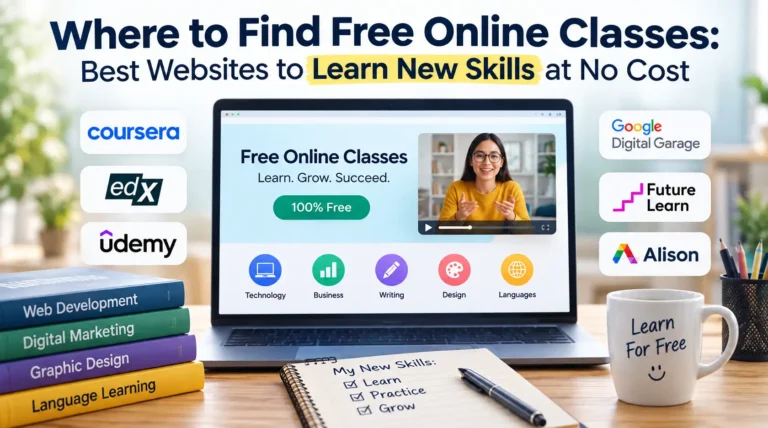
Want to learn something new without paying for college tuition or expensive training programs?
You may be surprised by how many free online classes are available. From computer programming and business to math, writing, health, languages, digital skills, and personal development, several reputable education platforms let you study from home.
Some platforms provide courses completely free, while others let you access course materials at no cost but charge for optional certificates or other credentials. Knowing the difference can help you avoid unexpected fees.
Here is a practical guide to some of the best places to find free online classes and courses.
🎓 What Are Free Online Classes?
Free online classes are educational courses or learning resources that you can access over the internet without paying tuition for the learning content.
Depending on the platform, a free class may include:
- Video lessons
- Reading materials
- Practice exercises
- Quizzes
- Assignments
- Lecture notes
- Discussion forums
- Projects
- Progress tracking
Not every “free course” works the same way. Some platforms offer the entire course at no cost, while others provide free access to course materials but charge if you want a certificate.
Always check the course’s pricing and certificate terms before enrolling.
🌟 Best Places to Find Free Online Classes
1. OpenLearn
OpenLearn is The Open University’s free learning platform.
It currently offers nearly 1,000 free courses covering subjects across the university’s curriculum. Courses range from short introductory lessons to longer learning experiences.
You can find classes covering areas such as:
- Education
- Health
- Psychology
- History
- Arts
- Science
- Mathematics
- Technology
- Computing
- Business
Some courses also offer a free digital badge or Statement of Participation. These are useful for showing that you completed learning, although they do not carry formal academic credit toward a qualification.
OpenLearn is particularly useful if you want genuinely free learning content rather than a platform that only offers a short free trial.
2. edX
If you want university-level learning, edX is worth exploring.
edX offers courses from universities and institutions around the world, with subjects including:
- Computer science
- Artificial intelligence
- Business
- Engineering
- Public health
- Mathematics
- Humanities
- Data science
edX explains that learners can audit courses at no cost, allowing them to explore course material without paying for a verified certificate.
Important
Free access and paid credentials are not always the same thing.
If your goal is simply to learn, the free audit option may be enough. If you need a verified certificate for employment or education, check the course’s current pricing.
3. Khan Academy
Khan Academy is one of the best-known resources for free academic learning.
It is especially useful for students who need help with:
- Mathematics
- Science
- Grammar
- Economics
- Computer programming
- History
- Test preparation
- Foundational academic skills
The platform combines instructional videos with practice exercises, making it useful for learners who want to study a topic step by step.
It can be particularly helpful for children, teenagers, college students, and adults who want to refresh academic basics.
4. MIT OpenCourseWare
Want to explore actual MIT course materials?
MIT OpenCourseWare publishes educational materials from MIT courses online.
You can find resources in areas such as:
- Computer science
- Engineering
- Mathematics
- Physics
- Economics
- Business
- Biology
- Chemistry
- Architecture
- Humanities
The major advantage is that you can study materials associated with a world-renowned university without paying traditional tuition.
Keep in mind that OpenCourseWare is primarily an open educational resource, not a traditional online degree program. Course materials may include lectures, readings, assignments, and exams, but completing them does not automatically give you college credit or a degree.
5. freeCodeCamp
If your goal is to learn programming or web development, freeCodeCamp is another strong option.
It focuses heavily on practical technology skills, including areas such as:
- HTML
- CSS
- JavaScript
- Responsive web design
- Front-end development
- Back-end development
- Python
- Data analysis
- Databases
It is designed around hands-on learning rather than simply watching videos.
That makes it a useful choice for someone who wants to practice coding while learning.
6. Saylor Academy
Saylor Academy provides open online courses in subjects such as:
- Business
- Computer science
- Mathematics
- Professional development
- Psychology
- English
- History
- Economics
It can be useful for independent learners who prefer self-paced education.
Before starting a course, review its current completion and certificate requirements so you know exactly what is included at no cost.
7. YouTube Educational Channels
YouTube is not a traditional college or online-course platform, but it contains an enormous amount of free educational content.
You can find lessons about almost anything:
- Excel
- Coding
- Photography
- Cooking
- Mathematics
- History
- Languages
- Marketing
- Graphic design
- Personal finance
- Science
- Technology
The challenge is quality control.
Anyone can upload educational content, so check the instructor’s qualifications, sources, date of publication, and reputation before relying on a video for important academic or professional information.
8. Free University Course Materials
Many universities publish free educational resources online.
Searching university websites for terms such as:
“free online course”
“open course materials”
“online lectures”
“OpenCourseWare”
can uncover useful resources.
Some universities provide complete courses, while others publish selected lectures, reading lists, assignments, or recordings.
The availability of certificates and academic credit varies.
💻 Best Free Online Classes by Subject
Different platforms are better suited to different goals.
| Subject | Good places to start |
|---|---|
| Math | Khan Academy, OpenLearn |
| Science | Khan Academy, OpenLearn, MIT OpenCourseWare |
| Computer Science | MIT OpenCourseWare, edX |
| Coding | freeCodeCamp, Khan Academy |
| Business | edX, OpenLearn, Saylor Academy |
| Writing | OpenLearn, university resources |
| History | OpenLearn, MIT OpenCourseWare |
| Psychology | OpenLearn, edX |
| Engineering | MIT OpenCourseWare, edX |
| Digital skills | OpenLearn |
| AI | edX, OpenLearn |
| Programming | freeCodeCamp, MIT OpenCourseWare |
| General education | OpenLearn, Khan Academy |
Course availability changes, so search the platform directly for the subject you’re interested in.
🏆 Free Online Classes With Certificates
One common misunderstanding is that every free online course automatically includes a free certificate.
That’s not always true.
There are several different situations:
Completely free course + free completion record
Some platforms provide free learning materials and a free statement, badge, or completion record.
OpenLearn, for example, says some of its courses provide free digital badges and Statements of Participation.
Free course + paid certificate
Some platforms allow you to study course material without paying but charge for a verified certificate.
edX specifically explains that learners can audit courses at no cost, while verified credentials may require payment.
Free educational resources + no certificate
OpenCourseWare resources may provide excellent learning material without functioning like a certificate-based course.
So if a certificate matters to you, always check the course’s current terms before investing your time.
👩💻 Free Online Classes for Career Skills
Free courses can be useful if you’re trying to improve your résumé or learn a new skill.
Popular areas include:
Technology
- Coding
- Web development
- Cybersecurity
- Data analysis
- Artificial intelligence
- Cloud computing
Business
- Marketing
- Project management
- Entrepreneurship
- Accounting
- Communication
- Leadership
Creative skills
- Graphic design
- Photography
- Writing
- Video editing
- Digital content creation
Office skills
- Excel
- Word processing
- Presentations
- Spreadsheets
- Digital communication
Before choosing a career course, look at the curriculum and determine whether it teaches a practical skill you can demonstrate through a project or portfolio.
👨👩👧 Free Online Classes for Kids
Parents can also use free educational platforms to supplement school learning.
Good subjects to explore include:
- Math
- Reading
- Science
- History
- Grammar
- Computer programming
- Art
Khan Academy is especially useful for academic practice, while OpenLearn offers a broad range of educational material for different levels.
Parents should check the age suitability of individual courses before allowing younger children to use an online platform independently.
👴 Free Online Classes for Seniors
Online learning isn’t just for students.
Older adults can use free classes to learn:
- Smartphone skills
- Computer basics
- Digital safety
- Photography
- Writing
- Art
- History
- Languages
- Personal interests
OpenLearn offers courses ranging from short learning activities to longer courses, including digital-skills topics.
For beginners, choose courses with simple instructions and self-paced lessons.
📱 Can I Take Free Classes on a Phone?
Yes.
Many online learning platforms work through a web browser or mobile application.
However, a laptop or desktop can be more convenient for:
- Programming
- Writing assignments
- Spreadsheet work
- Graphic design
- Long exams
- Research
- Online projects
If you only have a smartphone, start with courses that primarily use videos, readings, quizzes, or simple interactive exercises.
🆓 Are Free Online Classes Really Free?
Sometimes yes, but you should always read the fine print.
Look for these terms:
- Free course
- Free audit
- Free learning materials
- Free trial
- Paid certificate
- Subscription
- Upgrade required
- Financial assistance
Free trial does not mean free course.
A platform may let you access content for a limited period before charging you.
A free audit may also provide course materials without giving you graded assignments or a certificate.
🔎 How to Find Legitimate Free Online Classes
Before signing up, use these steps:
Step 1: Choose your goal
Ask yourself what you want to learn.
For example:
“I want to learn Python.”
is more useful than:
“I want to take a free course.”
Step 2: Search reputable platforms
Start with established education providers and universities.
Step 3: Check the course cost
Look for whether the course itself is free or only the introductory material is free.
Step 4: Check certificate fees
If you need a certificate, determine whether it costs extra.
Step 5: Read the curriculum
Make sure the lessons cover what you actually want to learn.
Step 6: Check the time commitment
Some courses take a few hours while others can take weeks or months.
Step 7: Start one course
Avoid enrolling in ten courses at once.
Complete one before moving to another.
⚠️ Watch Out for Fake Free Courses
The internet contains legitimate free education, but it also contains misleading offers.
Be careful if a website:
- Demands payment before showing basic course information
- Promises guaranteed employment
- Guarantees a high salary
- Claims a certificate is equivalent to a college degree
- Requires unusual payment methods
- Requests excessive personal information
- Uses pressure tactics
- Has no identifiable instructor or organization
A free class should not require you to surrender sensitive information unnecessarily.
When possible, use established universities and recognized education platforms.
📚 How to Get More From a Free Online Course
Getting access is only the first step.
Try this simple routine:
Choose → Schedule → Study → Practice → Finish
Choose one course
Pick something connected to your goal.
Set a schedule
Even 30 minutes a day can create steady progress.
Take notes
Write down important concepts in your own words.
Practice
Don’t only watch videos.
Complete exercises and projects whenever possible.
Finish
A completed beginner course is usually more useful than ten courses you started and abandoned.
Frequently Asked Questions
Where can I find completely free online classes?
Good starting points include OpenLearn, Khan Academy, MIT OpenCourseWare, freeCodeCamp, and selected free/audit courses on edX. The exact terms vary by platform.
Which website has the most free online courses?
There isn’t one universally largest or best platform for every subject. OpenLearn currently offers nearly 1,000 free courses, while other platforms have different catalogs and formats.
Can I take university classes online for free?
Yes. Platforms such as edX provide free audit access to selected university courses, while MIT OpenCourseWare publishes educational materials from MIT courses. Free access does not necessarily mean academic credit.
Can I get a certificate from a free online course?
Sometimes. Some courses offer free statements or badges, while other platforms charge for verified certificates. Check the individual course before enrolling.
Are free online classes good for getting a job?
They can help you build knowledge and practical skills. However, completing a free online course does not guarantee employment. For career development, focus on skills, projects, portfolios, experience, and credentials that employers actually value.
Are free online courses available for adults?
Yes. Adults can find courses covering professional skills, academic subjects, technology, creative skills, languages, and personal interests.
Can I take free online classes without going to college?
Yes. Many online courses are open to the public and do not require college enrollment.
Final Thoughts
You don’t always need to spend thousands of dollars to start learning something new.
OpenLearn, edX, Khan Academy, MIT OpenCourseWare, freeCodeCamp, Saylor Academy, and other reputable resources provide different ways to study online without traditional tuition.
The best platform depends on what you want to accomplish.
If you need academic practice, start with Khan Academy. If you’re interested in university-level material, explore edX or MIT OpenCourseWare. If you want practical coding experience, try freeCodeCamp. If you want broad, genuinely free learning content, OpenLearn is an excellent place to start.
Most importantly, check the pricing and certificate terms before enrolling. A course can be free to study while its certificate or other credentials cost money.
Pick one subject, choose one course, set aside regular study time, and start learning.
Your next skill could be only a few clicks away.