A college acceptance letter can bring excitement and a difficult question: how will the education be paid for? Tuition is only part of the bill. Housing, books, transport, and required equipment can leave a gap even after financial aid arrives.
Scholarships can help close that gap. However, the largest advertised award is not always the most useful opportunity. A smaller local award, a renewable college scholarship, or funding tied to a student’s field may fit an applicant much better.
This guide explains how scholarship funding works, where students can find credible opportunities, and how applications are evaluated. It also covers well-known national programs, state aid, graduate funding, and international study options. Each program link leads to its sponsor or official administrator so applicants can check the rules before committing time to an application.
The most practical starting point: students identify their education level, residency, financial circumstances, and intended course. Then they shortlist awards that match those details.
What Is a Scholarship?
A scholarship is financial support awarded for education under a sponsor’s eligibility and selection rules. Colleges, charities, employers, community organizations, and government agencies may provide it.
Awards can support tuition, fees, books, living costs, or other approved expenses. Some are paid directly to a school. Others are paid to the recipient. The award agreement determines how the money may be used.
Scholarships usually do not require repayment when their conditions are met. Nevertheless, service commitments, enrollment requirements, and other contractual terms deserve attention.
Main Types of Scholarships
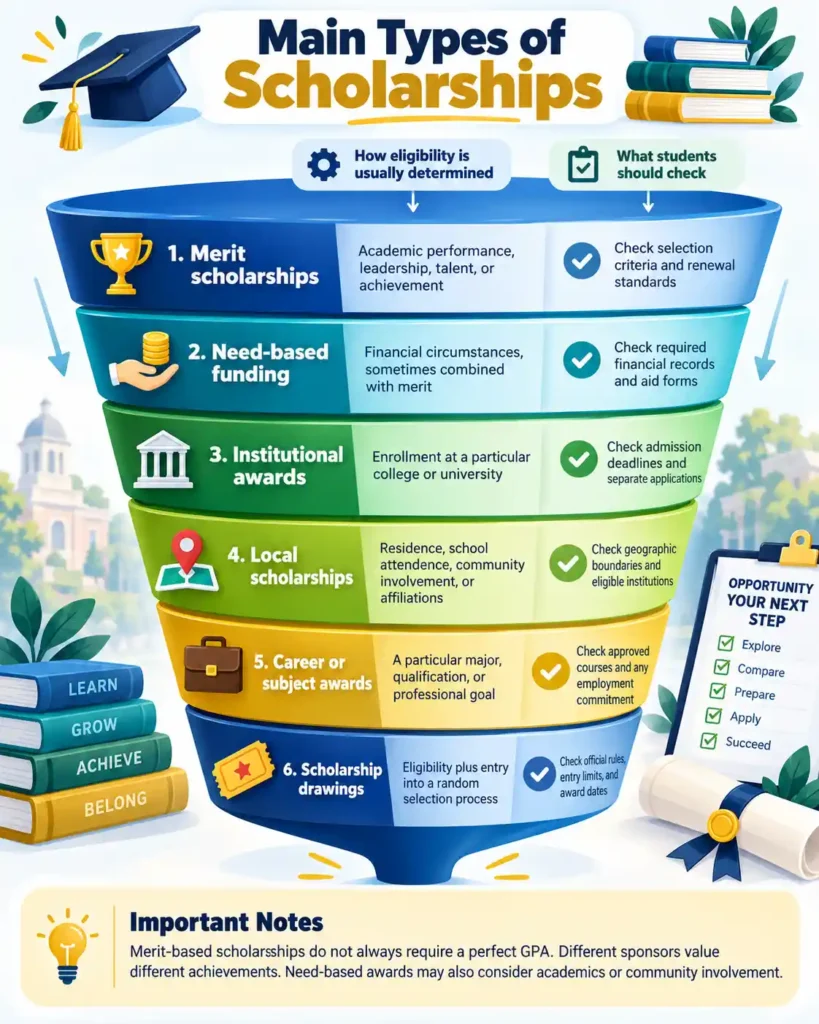
| Type | What usually determines eligibility | What students should check |
|---|---|---|
| Merit scholarships | Academic performance, leadership, talent, or achievement | Selection criteria and renewal standards |
| Need-based funding | Financial circumstances, sometimes combined with merit | Required financial records and aid forms |
| Institutional awards | Enrollment at a particular college or university | Admission deadlines and separate applications |
| Local scholarships | Residence, school attendance, community involvement, or affiliations | Geographic boundaries and eligible institutions |
| Career or subject awards | A particular major, qualification, or professional goal | Approved courses and any employment commitment |
| Scholarship drawings | Eligibility plus entry into a random selection process | Official rules, entry limits, and award dates |
Merit-based scholarships do not always require a perfect GPA. Different sponsors value different achievements. Likewise, a need-based award may still consider academic preparation or community involvement.
Which Scholarship Opportunities Fit Different Students?
The student’s stage of education helps narrow the search.
| Student situation | Useful places to begin |
|---|---|
| High school senior entering college | College admission awards, school counselors, community foundations, and eligible national programs |
| High school junior | Early scholarship programs, National Merit planning, and awards with junior-year deadlines |
| Current college student | Department awards, campus scholarship portals, professional associations, and renewed local funding |
| Community college transfer student | Transfer scholarships at receiving universities and dedicated transfer programs |
| Graduate or professional student | Department funding, fellowships, assistantships, and profession-specific awards |
| International applicant | The destination university, national scholarship agencies, and the appropriate Fulbright route |
| Adult learner or student parent | College aid offices, employer assistance, local foundations, and programs accepting returning students |
Eligibility comes before award size. A student gains little from preparing an excellent application for a program that excludes the student’s grade level, citizenship status, or intended institution.
Where Students Can Find College Scholarships
A useful search begins close to the student’s school and community, then expands to national opportunities.
College and Department Funding
A college’s admission office and financial aid office may offer different awards. Some scholarships are considered automatically during admission. Others require a separate application, interview, portfolio, or earlier priority deadline.
Current students should also check their department. An engineering student, nursing student, or education major may qualify for funding that does not appear on the university’s main admissions page.
For example, FIU scholarships include opportunities for different student groups. Applicants should use the relevant FIU admissions or scholarship instructions for their entry year.
Local Scholarships
School counselors, community foundations, civic groups, credit unions, employers, and professional associations can provide scholarship leads.
Local awards may have a narrower applicant pool. However, smaller competition cannot be assumed without evidence. Their practical advantage is that eligibility may closely match a student’s school, county, activities, or family connections.
A useful search combines a location with a genuine qualification, such as a county name and “nursing scholarship,” or a school district and “graduating senior awards.”
Financial Aid Applications
For eligible U.S. students, the FAFSA is an important part of the funding process. It can help schools determine eligibility for federal aid and other assistance. Some scholarships also request FAFSA information.
The form is not itself a scholarship application for every private award. Students may still need to apply separately to sponsors.
The site’s FAFSA eligibility and application guide explains the broader student aid process. Current instructions and the free federal application are available through Federal Student Aid.
Scholarships for High School Seniors and Future College Students
These programs illustrate different routes to undergraduate funding. They do not all accept applications at the same time, and none should be treated as an automatic award.
Programs That Consider Financial Need
| Official program | Who may find it relevant | Key condition or distinction |
|---|---|---|
| The Gates Scholarship | Outstanding high school seniors from low-income households | A selective last-dollar award; Pell eligibility and other published conditions apply |
| Jack Kent Cooke College Scholarship | High-achieving seniors with financial need | Funding considers educational costs and other aid; a separate transfer program also exists |
| QuestBridge National College Match | High-achieving seniors from low-income backgrounds | Combines an admission process with scholarship opportunities at partner colleges |
| Dell Scholars | Students meeting the program’s college preparation and financial criteria | The published 2027 cycle is specific to Texas high school seniors and eligible Texas public universities |
| Hagan Scholarship | Students meeting merit and financial eligibility rules | Applicants should check income, work, enrollment, and renewal conditions |
| Horatio Alger scholarships | Students facing financial need and significant adversity | Different programs serve different education stages, including career and technical study |
| Hispanic Scholarship Fund | Eligible students who identify as being of Hispanic heritage | HSF Scholar selection provides support services; a cash award depends on available funding |
| Folds of Honor | Eligible dependents and spouses of qualifying service members or first responders | The program has specific qualifying circumstances; a family connection alone is insufficient |
Two details deserve particular attention.
First, The Gates Scholarship calculates funding around eligible attendance costs, other financial aid, and its published contribution methodology. It is not a fixed cash payment offered to every low-income student.
Second, Dell Scholars has changed its published criteria for the 2027 cycle. Applicants must graduate from a Texas high school, participate in an approved college readiness program in grades 11 and 12, and plan to attend an accredited four-year public institution in Texas. Pell eligibility and a minimum 2.4 GPA also apply.
Achievement, Leadership, and Specialized Awards
| Official program | Main focus | Important application detail |
|---|---|---|
| Coca-Cola Scholars | Achievement, leadership, and service among eligible graduating seniors | The sponsor publishes annual eligibility and application rules |
| National Merit Scholarship Program | Academic competition beginning with the qualifying PSAT/NMSQT | The correct test year matters; participation and recognition do not guarantee a monetary award |
| NHS Scholarship | Scholarship, service, leadership, and character | Applicants need qualifying National Honor Society membership and adviser verification |
| Posse Scholarship | Leadership potential through a nomination and selection process | Recruitment locations and nomination arrangements determine access |
| Evans Scholarship | Eligible golf caddies with strong academics, character, and financial need | Caddie experience is a central qualification |
| Coolidge Scholarship | Academic excellence and other published selection criteria | Students apply as high school juniors; seniors are not eligible |
| Cameron Impact Scholarship | Academic achievement, leadership, and community impact | Covers tuition, fees, and books under its rules; early application limits can matter |
| Equitable Excellence Scholarship | Leadership and community impact among eligible seniors | Current cycle rules determine eligibility and renewal |
A student seeking a National Merit scholarship should speak with the school counselor before the qualifying test window. For students following a typical four-year high school schedule, the qualifying PSAT/NMSQT is taken in junior year.
State Scholarship Programs
Residency can open funding opportunities, but state awards have their own applications and renewal rules.
| Program | Where it applies | What students should understand |
|---|---|---|
| Florida Bright Futures Scholarship | Eligible Florida students attending qualifying institutions | Award categories have different academic and other requirements |
| HOPE Scholarship | Georgia’s program | Residency, academic eligibility, enrollment, and renewal rules apply |
| Excelsior Scholarship | Eligible New York students at SUNY or CUNY | A last-dollar tuition program with credit progress and post-award residency obligations |
| Arkansas Academic Challenge Scholarship | Eligible Arkansas students | Lottery-supported student aid administered through the state application system |
| Middle Class Scholarship | Eligible California students in qualifying public higher education programs | Eligibility and award calculations depend on current state rules and other resources |
The Arkansas Scholarship Lottery helps fund education awards. Students looking for an “Arkansas lottery scholarship” generally need the state’s scholarship application process, including Academic Challenge where appropriate. Buying a lottery ticket is not an application requirement.
The name HOPE also appears in programs outside Georgia. An applicant must identify the correct state sponsor before relying on an eligibility summary.
Bright Futures Scholarship Requirements
Bright Futures scholarship qualifications depend on the award category and the student’s graduation cohort. A single GPA or test score cannot describe every route.
Applicants should check:
- Florida residency and applicable citizenship or eligible noncitizen rules.
- The required high school diploma and qualifying coursework.
- The GPA calculation used for the chosen award category.
- Required test scores or an applicable alternative pathway.
- Volunteer service, paid work, or qualifying combinations under current rules.
- Submission of the Florida Financial Aid Application.
- Eligible college enrollment and later renewal requirements.
The Bright Futures Student Handbook provides the detailed requirements. Students should use the handbook applicable to their graduation year.
Excelsior Covers Tuition Under Specific Conditions
The Excelsior Scholarship does not automatically cover housing, food, transport, or every college fee. Other applicable aid is considered before the program covers remaining eligible tuition.
Recipients also face academic progress requirements and must agree to live in New York after receiving the award. Employment, when applicable, must meet the state’s work requirement. Failure to satisfy contractual obligations may cause award amounts to become a loan.
The aid office should explain these conditions before an applicant accepts the award.
Employer and Brand Scholarship Opportunities
Employment and family connections may create additional opportunities. However, not every award sponsored by a restaurant or brand requires an applicant to work there.
| Program | Main opportunity | Detail worth checking |
|---|---|---|
| Burger King Scholars / BK Scholars | Awards for qualifying seniors and eligible employees or family members | Different application tracks have different rules |
| Chick-fil-A Remarkable Futures | Education funding for qualifying restaurant team members | Employment and application requirements apply |
| Taco Bell Live Más Scholarship | Funding centered on passion, purpose, and a video application | Employee and nonemployee opportunities have separate rules |
| Dr Pepper Tuition Giveaway | A tuition competition governed by official contest rules | Applicants need a currently announced cycle; past promotions are not open applications |
| TYLENOL Future Care Scholarship | Funding for eligible students pursuing graduate healthcare education | The degree level and eligible healthcare courses matter |
The TYLENOL program is particularly relevant to graduate healthcare applicants. It should not be described as a scholarship available to every undergraduate interested in medicine.
Scholarship Websites and Search Platforms
Directories can make a search easier. They cannot replace the sponsor’s eligibility rules or guarantee that an applicant will receive money.
| Platform | What it offers | How students can use it |
|---|---|---|
| Fastweb | Profile-based scholarship matching | Students compare suggested matches with sponsor requirements |
| Scholarships.com | A scholarship directory and matching tools | Applicants confirm dates, amounts, and rules on the award page |
| Niche scholarships | Scholarship listings and Niche-sponsored opportunities | Students distinguish competitive awards from drawings |
| Bold.org scholarships | Donor-supported awards hosted on the platform | Each award’s qualifications and selection terms determine fit |
| Scholarships360 | Scholarship discovery and education resources | Students use the information to build a verified shortlist |
| Scholarship America | Applications for programs administered for different sponsors | Each sponsored program has its own eligibility |
| ScholarshipOwl | Scholarship matching and application-related tools | Applicants check free features, paid subscriptions, and cancellation terms |
| ScholarshipUniverse | Institutional scholarship management and matching | Students enter through their college’s verified scholarship or financial aid page |
| College Board BigFuture Scholarships | Award drawings linked to qualifying college planning activities | Completed steps create eligible entries rather than guaranteed awards |
ScholarshipUniverse is often a college-provided portal, rather than a single national scholarship with one public application.
Similarly, Scholarship America administers many sponsor programs. Applicants should identify the particular award rather than treating the organization’s name as one scholarship.
No-Essay Scholarships: Useful Extras, Limited Certainty
No-essay scholarships can be convenient. Some are random drawings; others use different selection methods. Their rules explain which applies.
Students should not build a college budget around an award they have not won. A short entry can be worthwhile, but it should sit alongside institutional aid and applications that closely match the student’s qualifications.
The absence of an essay does not establish that an award is easy to win.
Scholarships for College Students and Graduate Study
Scholarships for college students are not limited to awards received in high school. Enrolled students can check their department, professional organizations, campus fellowship office, and sponsors serving their course.
Graduate school scholarships may also appear under the names “fellowship,” “studentship,” or “funded research position.” Assistantships can involve teaching or research duties, so their funding terms differ from an unrestricted scholarship.
Research, Healthcare, and Service Programs
| Program | Relevant student group | Important condition |
|---|---|---|
| Barry Goldwater Scholarship | College sophomores and juniors planning research careers in science, mathematics, or engineering | Campus nomination is required; the campus deadline may come first |
| Truman Scholarship | Eligible college juniors preparing for public service careers and graduate education | Institutional nomination and later service conditions apply |
| SMART Scholarship-for-Service | Eligible undergraduate and graduate students in approved STEM fields | Funding is linked to a civilian employment service commitment |
| Nurse Corps Scholarship Program | Eligible students accepted into or enrolled in qualifying nursing degree programs | Recipients serve at eligible facilities with critical nursing shortages |
| NHSC Scholarship Program | Students in eligible primary care health profession training | Recipients serve at approved sites in health professional shortage areas |
| Army ROTC scholarships | Eligible students pursuing an officer commissioning route | Scholarship acceptance carries military obligations under the applicable agreement |
Nursing scholarships and NHSC funding serve different training routes. Neither program should be confused with a loan repayment program for professionals who already have qualifying debt.
A service award can be valuable when its career obligations fit the student. Applicants should understand eligible workplaces, required service length, and the consequences of failing to complete the agreement.
Law School Scholarships and Other Professional Degrees
Law school applicants should check each institution’s scholarship process. Some schools consider admitted applicants automatically. Others require separate forms or applications for particular awards.
A written award offer should explain whether renewal depends on good academic standing, a specified GPA, or another condition. Applicants should compare the scholarship with the total cost of the degree.
For other graduate students, department funding may be more relevant than general scholarship directories. A prospective doctoral student should ask whether an offer covers tuition, provides a stipend, includes health coverage, and guarantees funding for a stated period.
Scholarships for International Students and Study Abroad
Two searches often get mixed together: international students seeking a degree in another country, and students seeking funding for a semester abroad. Eligibility and application routes can differ substantially.
A university scholarship for an international degree applicant may not fund a short exchange. Likewise, a study abroad award may require enrollment at a home institution.
| Program | What it supports | Main eligibility distinction |
|---|---|---|
| Fulbright U.S. Student Program | Eligible overseas study, research, or English teaching opportunities | This route is for qualifying U.S. citizens |
| Fulbright Foreign Student Program | Opportunities for eligible international applicants to study or conduct research in the United States | Application arrangements depend on the applicant’s home country |
| Rhodes Scholarship | Postgraduate study at the University of Oxford | Applicants follow the appropriate constituency and eligibility rules |
| Gilman Scholarship | Eligible study abroad or internship programs | The program serves qualifying U.S. citizen undergraduates receiving Federal Pell Grants |
| Critical Language Scholarship | Intensive language study through the program’s announced offerings | U.S. citizenship or nationality, degree enrollment, and other criteria apply |
| Yale Young Global Scholars financial aid | Need-based assistance for the YYGS pre-college summer program | This is summer program funding, not a Yale undergraduate degree scholarship |
The phrase “Fulbright scholarship” covers different programs. The correct route depends on citizenship, country, education level, and proposed activity.
Students comparing scholarships to study overseas should calculate more than tuition. Travel, visa costs, insurance, accommodation, and required personal spending can affect affordability. EducationUSA’s funding guidance is a useful starting point for international students considering the United States.
For semester abroad scholarships, the home institution’s international office should confirm whether the chosen program qualifies and how any existing aid can be used.
Programs With Similar Names but Different Purposes
Some popular scholarship searches lead to school-choice support, savings plans, or country-specific benefits.
Step Up, NC Opportunity, and Georgia Promise
These programs should appear separately from college scholarship recommendations.
| Program | Main purpose | What families should verify |
|---|---|---|
| Step Up For Students | Administration of different Florida pre-K–12 education scholarship programs | The specific program, child’s eligibility, and approved uses |
| NC Opportunity Scholarship | Support for eligible North Carolina K–12 private school attendance | School participation, application rules, and award procedures |
| Georgia Promise Scholarship | Eligible K–12 education expenses through the state’s program | Residency, school-related eligibility, and approved expense rules |
A family seeking a “Step Up scholarship” needs the correct Florida program. A college applicant needs a different funding search.
Canadian Scholarship Trust
Canadian Scholarship Trust is associated with Registered Education Savings Plans, or RESPs. Families contribute to an education savings arrangement; it is not an automatic free college scholarship.
CST’s official explanation describes its plans. The CST Foundation also has separate education award initiatives. Applicants should distinguish a savings product from a bursary application and check the current terms of each.
UP Scholarship: Uttar Pradesh, India
The UP scholarship system relates to scholarship and fee reimbursement support in Uttar Pradesh. Eligibility depends on the applicable scheme, education level, category, and current rules.
The official UP scholarship portal is the starting point for current notices, applications, and status information. Students should identify whether they need a fresh or renewal application and the appropriate scheme.
The UP scholarship last date must be checked against the current official timetable. A search result labeled “UP scholarship last date 2025” describes an earlier period. It cannot establish a 2026–27 closing date. This guide does not supply an unverified current deadline.
How to Get a Scholarship for College
A strong application process is organized around fit, evidence, and deadlines. The following steps also help students avoid spending hours on unsuitable awards.
1. Build a Short Eligibility Profile
The profile should record the student’s education level, location, citizenship or eligible status, intended qualification, field of study, and expected enrollment date.
It can also include relevant employment, community involvement, family circumstances, and financial need. Sensitive documents do not belong in a public profile.
This profile makes it easier to reject unsuitable opportunities quickly.
2. Start With the School and Local Community
A practical shortlist includes institutional aid, relevant local awards, and selected national programs. These sources complement one another.
Students should ask whether scholarship consideration is automatic during admission. They should also ask whether transfer students, part-time students, and returning adults can qualify for different awards.
For student parents, the site’s guide to grants and support for single moms explains related assistance to investigate. Grant eligibility remains separate from scholarship eligibility.
3. Read the Rules Before Writing
The applicant should confirm the exact award year, eligible institutions, required enrollment, selection criteria, and renewal terms.
A program may reject an otherwise strong application because a required document arrives late. Nomination programs can also impose an earlier school deadline than the sponsor’s national deadline.
The calendar should include both dates.
4. Gather Evidence and Request Recommendations
Transcripts, activity records, financial documents, and references take time to prepare. Applicants should request recommendations early and provide the recommender with the award description.
A concise summary of the student’s goals and relevant work can help. However, applicants should not invent achievements or misrepresent responsibilities.
The sponsor’s instructions determine who may provide a recommendation and how it must be submitted.
5. Write to the Selection Criteria
A useful essay answers the actual prompt and supports its claims with specific examples.
For instance, an applicant describing leadership might explain a problem, the action taken, and the result. An applicant discussing adversity can explain its effect on education and the steps taken to continue.
A generic essay about ambition may miss the sponsor’s purpose. Reusing accurate background information can save time, but the final response should fit each award.
6. Check and Submit a Complete Application
Before submission, applicants should check word limits, file formats, document names, required signatures, and recommendation status.
The deadline’s time zone matters. An application due at 5 p.m. Eastern is not open until midnight in every location.
A submitted confirmation or application receipt should be saved. A draft in a portal is not evidence of completed submission.
7. Follow Up and Plan for Renewal
Applicants should monitor the email address used for registration, including spam folders. A finalist may need to provide additional records or complete an interview.
Recipients should then record renewal requirements. GPA, completed credits, enrollment status, annual forms, and service commitments can affect continuing eligibility.
A scholarship search is therefore useful before college and during enrollment.
Documents Commonly Required
The exact checklist varies by program. A reusable application folder can contain:
- A current transcript and requested test records.
- An activity, employment, and service summary.
- Personal statements or essays tailored to individual prompts.
- Recommendations submitted through the required process.
- Admission or enrollment evidence, where requested.
- FAFSA information or other financial records, if required.
- Residency or qualifying status documents, when necessary.
- A record of submitted applications and confirmation messages.
Students should submit sensitive records only through a verified sponsor process. Bank details, identity documents, and passwords should not be shared in response to an unsolicited scholarship message.
Scholarship Deadlines: A Dated Snapshot
The following information was checked on October 9, 2026. The table is a planning snapshot. Applicants should reopen the linked official program page before submitting.
| Program | Published application timing | Practical next step |
|---|---|---|
| Dell Scholars, 2027 cycle | Opened October 1, 2026; deadline January 12, 2027 | Students first check the Texas-specific eligibility requirements |
| Jack Kent Cooke College Scholarship | Published closing date: November 11, 2026 | Eligible seniors review the current application instructions |
| NHS Scholarship | November 20, 2026, at 5 p.m. Eastern | Applicants arrange adviser verification before the deadline |
| Critical Language Scholarship, 2027 program | November 17, 2026, at 8 p.m. Eastern | Students check citizenship, enrollment, and language requirements |
| Burger King Scholars, 2027–28 cycle | Opens October 15, 2026; closes December 15, 2026, or at 30,000 applications, whichever comes first | Eligible applicants prepare for an early submission |
Other programs may already have closed their current application window. For example, Coca-Cola Scholars states that its 2027 application is closed. The Fulbright U.S. Student Program also states that its 2027–28 application is closed.
An older article, cached search snippet, or an unchanged “open” banner can be misleading. The sponsor’s dated application instructions deserve priority. Where a page contains conflicting information, an applicant should ask the sponsor for clarification.
How Much Does a Scholarship Really Save?
The advertised amount is only one part of the decision.
A full-tuition scholarship generally addresses tuition under the award’s terms. A full-ride scholarship generally covers a broader set of attendance costs. Neither label should replace the written award agreement.
Students should compare the total cost of attendance after confirmed grants and scholarships. Loans and work-study are different forms of support; they should not be presented as scholarship money.
A Simple Comparison
The following figures are an illustration, not offers from actual colleges.
| Cost comparison | College A | College B |
|---|---|---|
| Annual attendance cost | $30,000 | $20,000 |
| Confirmed grants and scholarships | $15,000 | $8,000 |
| Remaining annual cost | $15,000 | $12,000 |
College A advertises more gift aid, but College B leaves a smaller remaining bill in this example.
Students should also ask the financial aid office how an outside award affects existing assistance. Colleges can have different scholarship stacking and aid adjustment policies. An award may reduce loans, replace other aid, or change the composition of a package.
The aid office should confirm the final effect in writing before a family relies on a particular savings estimate.
How Students Can Avoid Scholarship Scams
A credible sponsor explains eligibility, selection, payment, and contact procedures.
The Federal Trade Commission’s scholarship scam guidance identifies warning signs such as guaranteed awards, pressure to act immediately, and fees demanded to release scholarship money.
Students should be cautious when a message:
- Claims an award was won despite no recognizable application.
- Requests a payment to claim, redeem, or process the award.
- Asks for a StudentAid.gov password.
- Guarantees a scholarship regardless of qualifications.
- Cannot provide verifiable sponsor information or written rules.
A paid application service is a separate issue from a fee demanded to release an award. Free search options exist, and applicants should understand any subscription before signing up.
Frequently Asked Questions
Can Students Get Scholarships Without a Perfect GPA?
Yes. Some awards consider financial need, leadership, employment, community service, career goals, or other qualifications. Each sponsor sets its own minimum requirements.
Students should use verified eligibility filters rather than assume that every scholarship is based solely on grades.
Can Students Receive More Than One Scholarship?
Often, yes. However, award terms, college policies, and aid rules can affect how the awards combine.
Recipients should report outside funding as their institution requires and ask the aid office how it affects the final package.
Is ScholarshipOwl Legit?
ScholarshipOwl operates a scholarship matching and application service and publishes terms covering subscriptions and billing.
That does not establish that every feature is free or that an applicant will win an award. Students should check current charges, renewal terms, cancellation instructions, and the rules for each scholarship. Free directories and college aid offices provide alternatives.
Is a Presidential Scholarship the Same as U.S. Presidential Scholars?
No. Colleges may offer monetary awards called presidential scholarships under their own rules.
The federal U.S. Presidential Scholars Program is a recognition program. Its recognition does not itself include a monetary scholarship.
Can Students Still Apply for the Gates Millennium Scholarship?
The Gates Millennium Scholars Program selected its final cohort in 2016, according to the program’s published history.
The Gates Scholarship is a separate current program with its own application cycle and eligibility. The names should not be treated as interchangeable.
What Does “GG Scholarship” Mean?
The abbreviation is not enough to identify one award. Search results can refer to different sponsors, including GlamourGals scholarships or Rotary Global Grant scholarship opportunities.
Applicants need the full sponsor name, official application page, and applicable location before relying on an eligibility claim.
Are There Scholarships for Graduate Students Overseas?
Yes. Funding may come from destination universities, national agencies, foundations, and programs such as Rhodes or an applicable Fulbright route.
Applicants should match citizenship, education level, subject, and destination rules. Funding for a semester abroad may differ from an overseas graduate scholarship covering a complete degree.
What Happens If an Applicant Misses a Deadline?
The sponsor decides whether late materials are accepted. Applicants should check the written policy rather than assume an extension.
A missed deadline also creates time to prepare for the next cycle or investigate other currently open programs. Recommendation letters and reusable records can support later applications where permitted.
Conclusion: A Better Scholarship Search Begins With the Right Match
Scholarships can make education more affordable, but a long list of famous awards is only a starting point. The useful work is identifying which opportunities fit the student’s qualifications, preparing clear evidence, and submitting complete applications on time.
A strong funding plan combines college aid, relevant local opportunities, and carefully selected national or international programs. It also accounts for renewal rules, service obligations, and the expenses left after an award.
The clearest next step is manageable: an applicant builds a short verified list, records the deadlines, and begins the strongest matches first. That process turns an overwhelming search into a practical plan for paying for education.