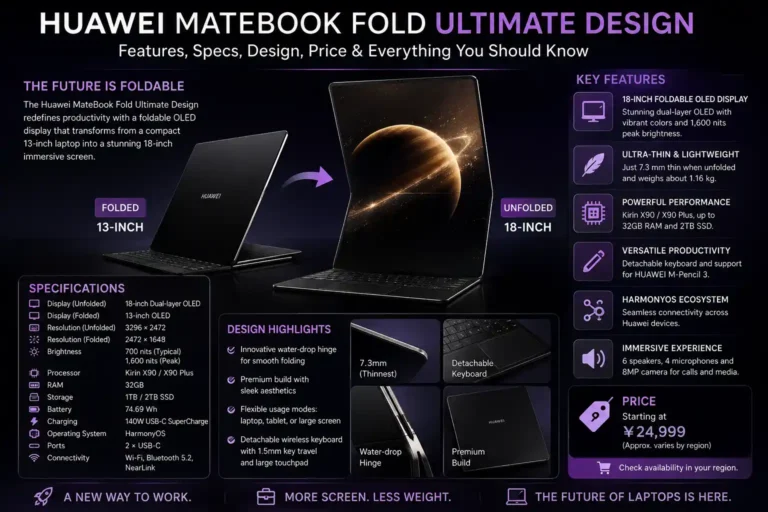
The Huawei MateBook Fold Ultimate Design is one of the most unusual laptops on the market. Instead of using a traditional laptop display, Huawei built the device around a foldable dual-layer OLED screen that expands from a compact 13-inch form into an 18-inch display.
The result is a device that tries to combine the portability of a laptop with the workspace of a large monitor.
What Is the Huawei MateBook Fold?
The Huawei MateBook Fold is a premium foldable computer designed around flexibility and portability. When folded, it provides a 13-inch working area. Open it completely and the display expands to an 18-inch OLED screen with a 4:3 aspect ratio.
Unlike traditional dual-screen laptops that use two separate panels, Huawei’s MateBook Fold uses one continuous flexible display. Its water-drop hinge is designed to allow the screen to open flat and support different viewing positions.
Huawei MateBook Fold Display
The display is the main attraction.
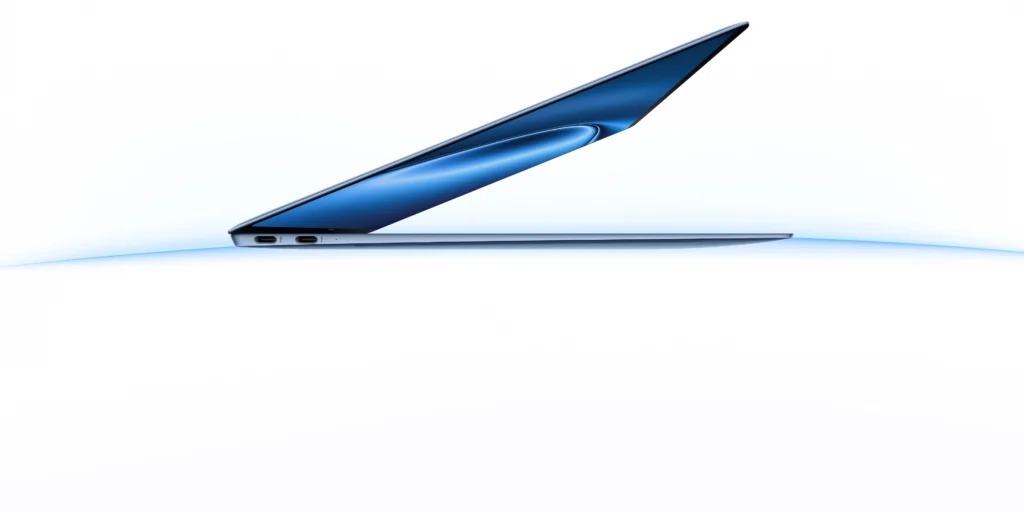
Huawei lists the MateBook Fold with an 18-inch dual-layer OLED flexible display when unfolded and a 13-inch display when folded. The unfolded resolution is 3296 × 2472, while the folded screen uses 2472 × 1648 resolution.
The screen also offers:
| Display Feature | Huawei MateBook Fold |
|---|---|
| Unfolded size | 18 inches |
| Folded size | 13 inches |
| Panel | Dual-layer OLED |
| Unfolded resolution | 3296 × 2472 |
| Folded resolution | 2472 × 1648 |
| Typical brightness | 700 nits |
| Peak brightness | Up to 1,600 nits |
| Color gamut | P3 |
| Screen-to-body ratio | 92% |
Huawei says the panel can reach 1,600 nits peak brightness for HDR content, while the typical brightness is 700 nits.
The 18-inch screen gives users significantly more space for multitasking, documents, creative work and entertainment without needing to carry a separate large monitor.
Thin and Lixghtweight Design
Despite its large display, the MateBook Fold is designed to stay highly portable.
Huawei lists the device at approximately 1.16 kg without the keyboard. When unfolded, it measures just 7.3 mm at its thinnest point, while the folded thickness is 14.9 mm.
That is particularly impressive considering the size of the unfolded screen.
TechRadar reported that the device weighed about 1.16 kg without its keyboard and around 1.45 kg with the keyboard attached, highlighting how portable the foldable design can be.
Performance and Hardware
Huawei equips the MateBook Fold Ultimate Design with its own Kirin X90 processor, according to the official specifications page. The listed configurations include 32GB of RAM and either 1TB or 2TB of SSD storage.
Huawei’s newer product page also promotes a Kirin X90 Plus configuration and says the platform is designed to work closely with HarmonyOS for improved overall performance.
For buyers, the exact processor and configuration should therefore be checked against the specific model being purchased.
HarmonyOS
The MateBook Fold is built around Huawei’s HarmonyOS ecosystem rather than Windows.
Huawei’s specifications list HarmonyOS 5, while the company’s newer product information references newer HarmonyOS versions and features available through updates.
The operating system is designed to work with Huawei’s broader ecosystem, including features for file sharing, device collaboration, cross-device clipboard functions and other connected-device tools.
Software compatibility is an important consideration, particularly for people who rely on Windows-specific applications. TechRadar noted that some mainstream software may not be compatible with HarmonyOS.
Keyboard and Productivity
The MateBook Fold comes with a detachable wireless keyboard in Huawei’s listed package. The keyboard uses Huawei’s NearLink wireless connection and has a 1.5 mm key travel along with a pressure-sensitive touchpad.
The flexible design allows the device to be used in different ways. You can work in a conventional laptop-like setup, unfold it for a much larger workspace, or use the large display for creative tasks.
Huawei also supports HUAWEI M-Pencil 3 input on newer versions of the product, allowing users to write, draw, annotate and take notes directly on the large screen.
Battery
The laptop uses a 74.69 Wh lithium-polymer battery, according to Huawei’s official specifications.
Huawei also includes a 140W USB-C SuperCharge adapter in the listed package.
Actual battery life will depend heavily on brightness, applications, connectivity, operating mode and whether you’re using the large unfolded display.
Cameras and Audio
The MateBook Fold includes an 8-megapixel front-facing camera for video calls. It also has six speakers and four microphones, making the device suitable for meetings, calls and media consumption.
The combination of a large 18-inch OLED display and six-speaker audio makes the device especially interesting for entertainment as well as productivity.
Ports and Connectivity
The slim design comes with a limited number of physical ports.
Huawei lists two USB-C ports and support for Wi-Fi, Bluetooth 5.2 and NearLink wireless connectivity.
For someone who frequently connects external displays, storage drives, memory cards or other accessories, a USB-C hub may be useful.
Who Is the Huawei MateBook Fold For?
The MateBook Fold makes the most sense for people who value portability and screen space.
It could appeal to professionals who travel frequently, designers who want a large canvas, writers working with multiple windows, students who want a portable workstation, and technology enthusiasts interested in foldable devices.
A large unfolded screen can also make multitasking much easier than working on a traditional 13-inch laptop.
Advantages
The biggest advantage is obviously the 18-inch foldable OLED display in a device that remains relatively light.
The design is also extremely thin, and the 1.16 kg weight without the keyboard makes it unusually portable for a computer with such a large potential workspace.
Other advantages include 32GB of RAM, up to 2TB of storage, a large battery, high display brightness, multiple usage modes and support for Huawei’s connected-device ecosystem.
Disadvantages
The biggest issue for many buyers may be the price and software ecosystem.
TechRadar reported an initial China price of ¥23,999, while Huawei’s current Chinese product page lists the Ultimate Design version from ¥24,999.
Availability is another consideration. Huawei’s product information and coverage indicate that the device has been focused on the Chinese market, so availability and software support can vary in other countries.
The foldable display also requires more care than a conventional laptop screen. Buyers should follow Huawei’s handling and screen-care guidance and recognize that foldable technology is more complex than a standard panel.
Huawei MateBook Fold vs Traditional Laptop
A traditional laptop remains the better choice for many people.
A standard Windows or macOS laptop usually offers broader software compatibility, a familiar keyboard and operating system, and often a lower price.
The MateBook Fold is different. Its biggest selling point isn’t simply speed. It’s the ability to carry an 18-inch workspace in a device that folds into a much smaller form factor.
For someone who values portability and a huge screen, that difference could be worth paying for.
Is the Huawei MateBook Fold Worth It?
The Huawei MateBook Fold Ultimate Design is a bold experiment in the future of laptop design.
It combines an 18-inch OLED display, a lightweight foldable chassis, up to 32GB RAM and 2TB storage, a large battery and Huawei’s HarmonyOS ecosystem in a single device.
Its biggest appeal is simple: you get a huge screen without carrying a huge traditional laptop.
However, the premium price, limited availability and HarmonyOS software compatibility are factors buyers should carefully consider before purchasing.
Final Verdict
The Huawei MateBook Fold Ultimate Design is not an ordinary laptop. It’s aimed at people who want something thinner, lighter and more innovative than a conventional computer.
For travelers, creators and tech enthusiasts, the 18-inch foldable display could be the feature that makes it stand out.
For everyone else, a traditional laptop may still provide better value and broader software compatibility.
Either way, Huawei has shown that the future of laptops may not be about making screens smaller — it could be about making them foldable.