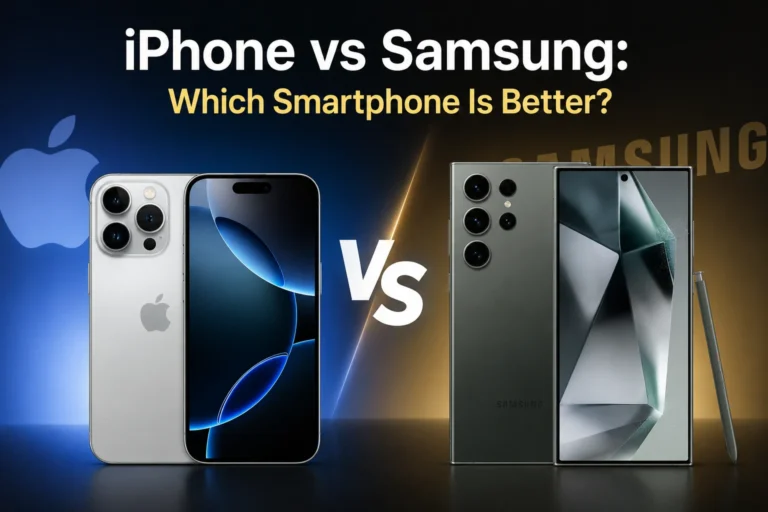
Choosing between an iPhone and a Samsung smartphone is one of the biggest decisions for anyone buying a new phone. Both brands lead the global smartphone market and offer premium devices packed with powerful hardware, advanced cameras, long software support, and innovative features.
The debate over iPhone vs Samsung has continued for years because each brand has its own strengths. Apple focuses on simplicity, seamless integration, privacy, and long-term software support. Samsung offers greater hardware variety, customization, larger displays, faster charging, and cutting-edge innovations across different price ranges.
Whether you’re upgrading your current phone or switching from one platform to another, understanding the differences can help you make the right choice. The best phone isn’t the same for everyone—it depends on your budget, daily needs, and the features you value most.
This guide compares Samsung vs iPhone in every important category, including design, display, performance, cameras, battery life, and charging, so you can confidently decide which smartphone is right for you.
iPhone vs Samsung Comparison at a Glance
| Feature | iPhone | Samsung Galaxy |
|---|---|---|
| Operating System | iOS | Android (One UI) |
| Build Quality | Premium aluminum/titanium | Premium aluminum/titanium |
| Display | Super Retina XDR OLED | Dynamic AMOLED 2X |
| Refresh Rate | Up to 120Hz (Pro models) | Up to 120Hz |
| Camera Quality | Natural colors and excellent video | Highly versatile with advanced zoom |
| Battery Life | Excellent optimization | Larger batteries on many models |
| Charging | Fast wired and MagSafe wireless | Faster wired and wireless charging |
| Software Updates | Typically 5–7 years | Up to 7 years on flagship models |
| Customization | Limited | Extensive |
| App Ecosystem | Excellent optimization | Larger customization options |
Design and Build Quality
When comparing iPhone vs Samsung, both companies build premium smartphones that feel durable and comfortable to use.
Apple follows a simple design philosophy. Recent iPhone models feature flat edges, premium materials such as titanium on Pro models, and a clean, minimal appearance. Apple rarely changes the overall design dramatically from one generation to the next, giving iPhones a recognizable look.
Samsung takes a different approach. Galaxy smartphones often feature slimmer bezels, curved or nearly edge-to-edge displays on some models, and modern camera layouts. Samsung also introduces fresh design updates more frequently, making each generation look distinct.
iPhone Design Advantages
- Premium finish
- Strong build quality
- Excellent durability
- Comfortable one-handed use
- Consistent design language
Samsung Design Advantages
- Larger display options
- Slim bezels
- Lightweight construction
- More color choices
- Foldable phone options
Neither company has a clear advantage in build quality. Both produce some of the highest-quality smartphones available today.
Display Comparison
The display is one of the biggest reasons people choose between Samsung and Apple.
Samsung has long been known for producing some of the world’s best smartphone displays. Even Apple purchases OLED display panels from Samsung for several iPhone models.
Samsung’s Dynamic AMOLED displays offer:
- Rich colors
- Deep blacks
- Excellent brightness
- Smooth scrolling
- Outstanding outdoor visibility
Apple’s Super Retina XDR displays focus on:
- Accurate color reproduction
- Excellent brightness
- HDR performance
- Smooth animations
- True Tone technology
Which Display Is Better?
Samsung generally appeals to users who enjoy vibrant colors and highly customizable display settings.
Apple focuses on natural-looking colors and accurate calibration, making photos and videos appear realistic.
Both support:
- OLED technology
- HDR content
- Adaptive refresh rates
- Always-On Display (selected models)
For most users, either display will look fantastic.
Performance
Performance is another major factor in the Samsung vs iPhone comparison.
Apple designs both its hardware and software together, allowing iPhones to deliver exceptional speed even with less RAM than many Android phones.
Every new iPhone generation includes a powerful processor capable of handling:
- Gaming
- Video editing
- Multitasking
- AI features
- Professional apps
Samsung uses flagship processors that also deliver excellent performance. Combined with higher RAM options, Galaxy phones easily handle demanding applications and multitasking.
Everyday Performance
Both brands easily manage:
- Social media
- Streaming
- Photography
- Productivity apps
- Video calls
- Navigation
Most users will notice little difference during everyday use.
Heavy Workloads
If you edit videos, play graphics-intensive games, or frequently multitask, both flagship iPhones and Samsung Galaxy phones provide more than enough power.
Performance differences are now much smaller than they were several years ago.
Camera Comparison
One of the biggest reasons people compare iPhone or Samsung is camera quality.
Both companies produce outstanding cameras, but their styles differ.
iPhone Cameras
Apple focuses on consistency.
Photos generally feature:
- Natural colors
- Balanced exposure
- Excellent skin tones
- Reliable portrait mode
- Industry-leading video recording
Content creators often choose iPhones because video quality remains among the best available.
Samsung Cameras
Samsung emphasizes versatility.
Depending on the model, Galaxy phones may include:
- Ultra-wide cameras
- High-resolution main cameras
- Advanced zoom capabilities
- Macro photography
- Powerful night photography
Samsung also gives users more manual camera controls.
Photo Quality
During daylight, both brands produce excellent images.
Apple typically delivers:
- Realistic colors
- Consistent results
- Excellent HDR
- Natural processing
Samsung often delivers:
- More vibrant colors
- Sharper appearance
- Higher contrast
- Eye-catching images for social media
Neither approach is objectively better—it depends on personal preference.
Video Recording
Video remains one of Apple’s strongest advantages.
iPhones consistently provide:
- Stable recording
- Excellent dynamic range
- Smooth autofocus
- High-quality audio
- Reliable low-light video
Samsung has improved dramatically over recent years and now offers impressive video performance, including high-resolution recording and professional shooting modes.
Zoom Performance
Zoom photography is an area where Samsung often has the advantage.
Many Galaxy flagship phones include advanced telephoto systems capable of capturing detailed distant subjects.
This makes Samsung a strong choice for:
- Wildlife photography
- Sporting events
- Concerts
- Travel photography
Apple continues improving its zoom capabilities, but Samsung generally offers greater flexibility for long-distance photography.
Battery Life
Battery life has become a major deciding factor for smartphone buyers.
Apple achieves impressive battery performance through software optimization.
Samsung often includes larger battery capacities, especially on Ultra and Plus models.
In normal daily use, both brands typically provide all-day battery life.
Battery performance depends on:
- Screen brightness
- Gaming
- Video streaming
- Camera usage
- Network strength
- Background applications
Heavy users may still need to recharge before bedtime, regardless of the brand.
Charging Speed
Charging is one area where Samsung usually offers faster technology.
Samsung smartphones often support higher wired charging speeds, allowing users to recharge more quickly.
Apple supports:
- Fast wired charging
- Wireless charging
- MagSafe accessories
- Reverse charging through some accessories
Samsung supports:
- Fast wired charging
- Fast wireless charging
- Wireless PowerShare on supported devices
- Wide compatibility with USB-C accessories
If rapid charging is your priority, Samsung generally has an advantage.
Which Brand Wins So Far?
After comparing design, display, performance, cameras, battery life, and charging, it’s clear that both brands excel in different areas.
- Choose an iPhone if you value a polished user experience, excellent video recording, consistent performance, and seamless integration with other Apple devices.
- Choose Samsung if you want greater customization, faster charging, larger displays, more camera flexibility, and advanced hardware features.
Software Experience
Software is one of the biggest differences in the iPhone vs Samsung comparison.
Apple uses iOS, while Samsung uses Android with its own One UI interface. Both are polished, secure, and packed with useful features, but they offer different user experiences.
iPhone (iOS)
Apple is known for keeping iOS simple and easy to use. Menus are clean, animations are smooth, and updates are released to all supported iPhones at the same time.
Advantages include:
- Simple interface
- Fast software updates
- Excellent app optimization
- Smooth long-term performance
- Strong privacy controls
If you prefer a phone that “just works” with minimal setup, iOS is an excellent choice.
Samsung (One UI)
Samsung’s One UI gives users much more freedom to customize their phones.
You can personalize:
- Home screens
- Widgets
- Themes
- Icons
- Lock screens
- Always-On Display
- Multitasking features
Samsung also includes productivity tools such as split-screen mode, floating windows, and desktop-like experiences on supported devices.
If you enjoy customizing your smartphone, Samsung is the better option.
AI Features
Artificial intelligence has become a major selling point for modern smartphones.
Both Apple and Samsung now include AI-powered tools that help improve productivity, photography, writing, translation, and everyday tasks.
Common AI features include:
- Writing assistance
- Live translation
- Photo editing
- Smart search
- Voice assistants
- Image enhancement
- Call assistance
Both companies continue adding new AI capabilities through software updates, making their flagship phones smarter every year.
Security and Privacy
Security is important for every smartphone user.
Apple has built a strong reputation for protecting user privacy. iPhones include features that let you control app permissions, tracking, and data sharing.
Samsung also provides excellent security through features such as Samsung Knox, biometric authentication, and secure folders that protect sensitive files and apps.
Both brands offer:
- Fingerprint or facial authentication
- Device encryption
- Regular security updates
- App permission controls
- Find My Device features
For most users, both platforms provide excellent protection against common security threats.
Ecosystem
Your decision may depend on the devices you already own.
Apple Ecosystem
If you use products like:
- Mac
- iPad
- Apple Watch
- AirPods
An iPhone integrates seamlessly with them.
Features such as file sharing, clipboard syncing, messaging, and video calls work smoothly across Apple devices.
Samsung Ecosystem
Samsung also offers an impressive ecosystem that includes:
- Galaxy tablets
- Galaxy Watches
- Galaxy Buds
- Galaxy laptops
Samsung devices work well together and integrate nicely with Windows PCs, making them attractive for users who prefer Android.
Gaming Experience
Gaming performance is excellent on both platforms.
Modern iPhones and Samsung flagship phones can handle demanding games without difficulty.
iPhone Gaming Advantages
- Excellent optimization
- Consistent frame rates
- Strong developer support
- Long software support
Samsung Gaming Advantages
- Larger displays
- More RAM options
- Advanced cooling on flagship models
- Gaming customization features
Casual gamers will be happy with either device, while competitive gamers may choose based on personal preference and the specific games they play.
Price and Value
Price is one area where Samsung offers more variety.
Apple mainly focuses on premium devices, although older iPhone models remain available at lower prices.
Samsung offers smartphones across almost every price range, including:
- Budget phones
- Mid-range devices
- Premium flagships
- Foldable smartphones
This makes Samsung a better option for shoppers with different budgets.
If you’re looking for the very best flagship experience, both brands offer premium models that compete closely.
Which Phone Is Best for Different Users?
Best for Students
Winner: Samsung
Samsung offers more affordable smartphones without sacrificing essential features, making it easier for students to find a device that fits their budget.
Best for Business Users
Winner: iPhone
Apple’s stability, long software support, and strong privacy features make iPhones a popular choice for professionals.
Best for Photography
Tie
Choose an iPhone if you prioritize:
- Video recording
- Natural-looking photos
- Consistent image quality
Choose Samsung if you prefer:
- Powerful zoom
- More camera options
- Vibrant photos
- Manual camera controls
Best for Gaming
Tie
Both brands provide outstanding gaming performance.
Your decision should depend on which operating system you prefer.
Best for Battery and Charging
Winner: Samsung
Samsung generally offers:
- Larger batteries
- Faster wired charging
- Faster wireless charging
Best for Simplicity
Winner: iPhone
If you want a phone that’s easy to use without extensive customization, Apple is the better choice.
Best for Customization
Winner: Samsung
Samsung gives users much greater control over how their phone looks and functions.
iPhone Pros and Cons
Pros
- Excellent performance
- Outstanding video recording
- Long software support
- Strong privacy features
- Easy to use
- Premium build quality
- Excellent resale value
Cons
- Limited customization
- Higher prices
- Slower charging than many competitors
- Fewer budget options
Samsung Pros and Cons
Pros
- Excellent displays
- Fast charging
- Great camera versatility
- Wide range of models
- Extensive customization
- Larger batteries
- Strong value for money
Cons
- Software experience varies by model
- Some apps are better optimized for iPhone
- Premium models can be expensive
Final Verdict
The iPhone vs Samsung debate doesn’t have a single winner because both brands make outstanding smartphones.
Choose an iPhone if you want:
- A simple user experience
- Excellent performance
- Industry-leading video recording
- Strong privacy
- A seamless Apple ecosystem
Choose a Samsung Galaxy phone if you want:
- More customization
- Faster charging
- Better zoom capabilities
- Larger display options
- Greater choice across different budgets
Ultimately, the best smartphone is the one that matches your needs, budget, and the ecosystem you already use.
Frequently Asked Questions
1. Which is better, iPhone or Samsung?
Neither is universally better. iPhone is known for simplicity, performance, and ecosystem integration, while Samsung offers greater customization, hardware variety, and faster charging.
2. Is Samsung better than iPhone?
Samsung may be better if you want Android, extensive customization, larger displays, and advanced camera zoom features.
3. Is iPhone better than Samsung?
An iPhone may be the better choice if you value long software support, smooth performance, excellent video recording, and seamless integration with other Apple devices.
4. Which phone has the better camera?
Both produce excellent photos. iPhone excels in video and natural colors, while Samsung offers more versatile camera systems and stronger zoom performance.
5. Which phone lasts longer?
Both Apple and Samsung now provide years of software and security updates for their flagship devices, allowing users to keep their phones for a long time.
6. Which phone is better for gaming?
Both are excellent gaming phones with powerful processors and high-refresh-rate displays on flagship models.
7. Which phone has better battery life?
Battery life depends on the specific model, but both brands offer all-day performance on their premium smartphones.
8. Which phone is easier to use?
Many users find the iPhone easier to use because of its simple interface, while Samsung offers more advanced customization options.
9. Which phone offers better value?
Samsung offers devices across a wider range of prices, making it easier to find a phone that fits different budgets.
10. Should I buy an iPhone or a Samsung phone in 2026?
Choose the one that best fits your budget, preferred operating system, and the features that matter most to you. Both brands offer some of the best smartphones available today.